Parsippany Elite Roofing provides chimney repair in Parsippany, NJ and has worked on roofs across the area for more than 20 years, serving surrounding cities including Hanover, East Hanover, Denville, Florham Park and West Caldwell. The chimney is one of the most common places a roof leaks. Water and snow collect on its uphill side, the flashing that seals it to the roof ages faster than the shingles around it, and the masonry itself can let water soak through.
Our chimney work focuses on everything above the roofline. That includes step and counter flashing, the cricket on the uphill side, the crown that caps the masonry, the chimney cap over the flue, and the mortar joints in the exposed brick. Fixing all of those together is what keeps water out for good.
Every chimney repair starts with a look from the roof and from the attic. Stains on the masonry inside the attic, damp framing around the chimney and daylight through gaps all help us find exactly where the water is getting in.
Chimney Flashing Repair
Step Flashing Along the Sides
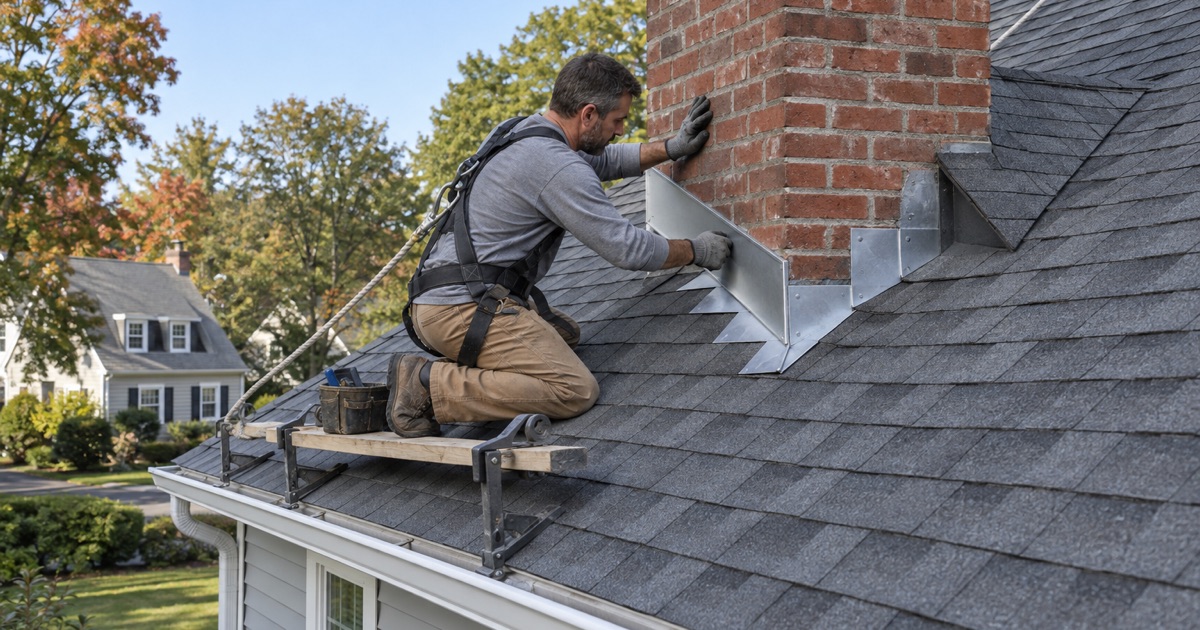
Step flashing is a series of L-shaped metal pieces woven into each course of shingles along the sides of the chimney. Each piece overlaps the one below it, so water runs down and out onto the roof. When pieces are missing, rusted or bent, water slips behind the shingles.
We remove the shingles beside the chimney, install new step flashing course by course, and relay the shingles over it. This is careful, detailed work. It is also the only way to rebuild the seal properly.
Counter Flashing Cut Into the Masonry
Counter flashing covers the top edge of the step flashing and is set into the chimney itself. Done properly, it is cut into a reglet, a groove in the mortar joint, and sealed there. On many older chimneys we find counter flashing that is only glued to the face of the brick with sealant.
Surface-mounted flashing fails as the sealant dries out and the brick moves with the seasons. We cut a proper reglet, set new counter flashing into it and seal the joint. That detail lasts far longer than a bead of caulk.
Apron Flashing on the Downhill Side
The front face of the chimney, on the downhill side, gets a single apron flashing that laps over the shingles below. It carries water from the front of the chimney back onto the roof. Old aprons often rust through at the corners where they meet the step flashing.
We replace the apron and fold its corners into the side flashing so the transitions stay sealed. Together, the apron, step and counter flashing form one continuous system around the chimney.
Crickets and Water Diversion
Why Wide Chimneys Need a Cricket
On the uphill side of a chimney, water and snow come straight down the roof and pile up against the brick. On a narrow chimney, they can flow around it. On a wider one, they pond, back up under the shingles and find any gap in the flashing.
The residential code requires a cricket behind chimneys wider than 30 inches for exactly that reason. A cricket is a small peaked roof framed on the uphill side that splits the water to both sides. Many older homes in the area were built without one.
Building and Flashing the Cricket
We frame the cricket, sheathe it, and cover it with ice and water barrier before finishing it with shingles or metal. Its valleys tie into the main roof like any other valley. The flashing where it meets the brick is cut into the masonry like the counter flashing.
Adding a cricket during a chimney repair or roof replacement is far easier than adding one later. If your chimney is wide and leaks on its uphill side, a missing cricket is often the reason.
Masonry, Crowns and Caps
Chimney Crown Repair
The crown is the concrete or mortar slab that covers the top of the chimney around the flue. It should slope away from the flue and overhang the brick so water drips clear of the chimney. Cracked or flat crowns let water soak into the masonry from the top.
We seal minor cracks and rebuild crowns that are badly cracked or poorly shaped. A sound crown protects the whole chimney below it. It is one of the most cost-effective repairs on an aging chimney.
Chimney Caps
A chimney cap sits over the flue opening to keep rain, snow, leaves and animals out. Without one, water runs straight down the flue and can damage the liner, the damper and the masonry. Birds and squirrels also find open flues inviting.
We install caps sized to the flue and fastened securely. Multi-flue chimneys may get a single cap that covers all flues. The cap also keeps debris from blocking the flue.
Repointing Mortar Joints
Mortar joints wear away over decades of rain, freezing and thawing. Once the joints are open, water soaks into the brick and can freeze, cracking the face of the bricks and loosening them. Stains, missing mortar and loose bricks are all signs that repointing is needed.
Repointing means grinding out the damaged mortar and packing in new mortar to restore the joints. We do this on the exposed portion of the chimney above the roof. Badly damaged chimneys may need rebuilding from the roofline up, and we explain when that is the better option.
Chimneys and Roof Replacement
Replacing Flashing With a New Roof
When we replace a roof, chimney flashing is replaced with it rather than reused. Old flashing that was fine under the old shingles rarely seals properly against new ones. It is one of the most common reasons a new roof leaks in its first year.
If the crown, cap or mortar needs work, the roof replacement is a good time to handle it. The crew is already on the roof, and the masonry repairs can be finished before the new shingles go down around them. That keeps the whole chimney and roof working as one system.
- 20+ Years on Local Roofs
- Itemized Written Scopes
- Same-Day Storm Tarping