Parsippany Elite Roofing has handled roofing in East Rutherford and across northern New Jersey for more than 20 years, and our work here starts with a question many roofers skip: how exposed is this particular house to wind? We answer it address by address before recommending a shingle, a fastening pattern or an edge detail, because the right choice depends on what lies beside the lot.
Every leak call still begins in the attic as well as on the roof, so we find where the water actually gets in before anyone prices a fix. You get a straight answer on whether repair will do before replacement comes up at all. When replacement is the honest call, our written scope breaks out tear-off, decking, underlayment, flashing, ventilation and gutters as separate lines.
That format lets you set our estimate beside any other and compare the two item by item. Below we explain why the eastern edge of town can change the wind assumptions for a house roof, what that means for materials and nailing, and how the borough’s many two-family buildings shape the job. None of it is a reason to overbuild every roof, only a reason to check before choosing.
Where the Meadowlands District Line Meets the Houses
Route 17 as the Dividing Line
East Rutherford is one of the 14 municipalities of the Hackensack Meadowlands District, but the District does not take in the whole borough. A zoning map produced in July 2015 by the New Jersey Sports and Exposition Authority, successor to the old Meadowlands Commission, draws the District boundary along Route 17. The map says it is not an official State map and it predates the borough’s 2026 rezoning, so we read it as a guide, not a survey.
West of the highway lie all of the borough’s residential zones: Low Density R1, Medium Density R2 and Multi-Family R3, with commercial strips along the highway edge. East of it the map shows only District zones. Those include conservation land along Berry’s Creek and the Hackensack River marshes, redevelopment and light industrial parcels, and the sports and expositions zone around the stadium complex.
What the Boundary Means for a Re-Roof
On District land, New Jersey Administrative Code 19:4-4.2 requires a zoning certificate from the Authority before construction, remodeling or reconstruction begins, except for demolition and maintenance. That is a question for commercial and industrial owners east of the highway. Because the map places the borough’s houses outside the line, a homeowner replacing a roof here deals with the borough office rather than the Authority.
The Borough of East Rutherford Building Department at 312 Grove Street is the local enforcing agency under the state Uniform Construction Code, with Keith Matino serving as Construction Official. Whether a particular roofing job needs a permit depends on the house and the scope of work. We confirm that with the office for each project rather than assuming an answer either way.
Why the Open Ground Still Matters
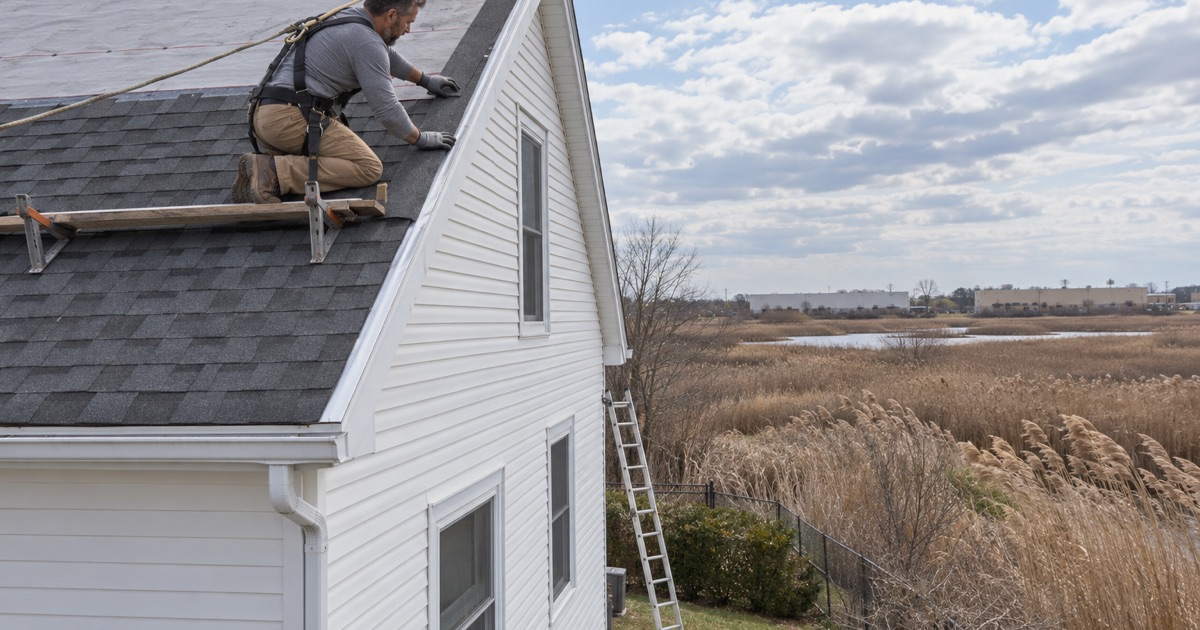
Sitting outside the District does not leave a house untouched by it. The marshes, open lots and broad redevelopment ground east of Route 17 also leave long stretches with few tall obstructions. Wind crossing that kind of terrain keeps more of its speed when it reaches the first row of buildings, and that makes exposure a structural question for a roof rather than a zoning one.
For the blocks facing that ground, it is as much a feature of the site as a chimney or a skylight, and it belongs in the roof plan. The question is how much open ground, in which direction and for how far, which is exactly what the residential code asks.
Looking for roofing closer to Hasbrouck Heights? See Roofing Services in Hasbrouck Heights.
Exposure B, Exposure C and the 600-Foot Test
New Jersey’s one- and two-family dwelling subcode, built on the 2021 International Residential Code as amended, sorts building sites into wind exposure categories under Section R301.2.1.4. Exposure B is assumed unless a site meets the definition of another category. In practice that default fits the typical built-up street, where neighboring houses, garages and trees break up the wind near the ground.
When Open Terrain Changes the Category
Exposure C is open terrain with scattered obstructions generally less than 30 feet high, extending more than 1,500 feet from the building site in any quadrant. The code also moves a building that sits in Exposure B terrain into Exposure C when it is directly adjacent to open Exposure C terrain for more than 600 feet in any quadrant. That adjacency clause is the one that can reach a house at the edge of an otherwise built-up street.
We do not assume any East Rutherford lot meets that test, and nobody should. Which houses on the eastern blocks face more than 600 feet of open ground has not been measured, and the answer can differ from one side of a street to the other. What the map does show is residential blocks facing Route 17 and, beyond it, District marsh, redevelopment ground and the sports complex.
Why a ZIP Code Lookup Falls Short
Exposure and design wind speed are decided for an address, not for a town. The state Department of Community Affairs, in Bulletin 19-1, has cautioned that lookups by city or ZIP code can underestimate the wind a site should be designed for. On the eastern side of the borough, we look at what actually lies beside the house in each direction before we choose a product or a nailing pattern.
For houses deeper into town, the default Exposure B assumption may well hold, and the roof can be specified on that basis. For a house at the edge of open ground, we record the exposure question in the written scope, so you can see why a particular shingle or fastening choice was made and compare it fairly against another bid.
Wind Ratings, Starter Strips and Edge Nailing
Exposure matters to a roofer because shingle wind ratings and edge fastening are chosen against a site’s design wind rather than a town-wide figure. Uplift is strongest at the eaves, rakes and ridge, and most wind damage starts where a loose edge lets air under the first course. An exposed roof gets more care at those edges, not a different approach everywhere else.
Shingle Wind Classifications
Asphalt shingles are tested for wind resistance under ASTM D3161, where Class F is the top rating, and under ASTM D7158, where Class H is the highest. Architectural shingles such as GAF Timberline HDZ, Owens Corning Duration and CertainTeed Landmark are sold with published wind classifications that depend on installation exactly as the manufacturer specifies. We match the rating to the address and write the product and its class into the scope.
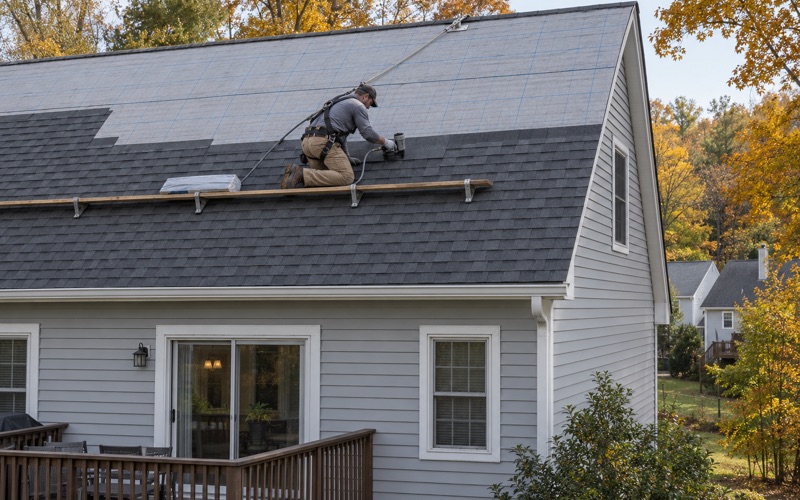
Those instructions are where an exposed roof is won or lost. Many manufacturers call for a high-wind nailing pattern, with more fasteners per shingle, to reach their top rating or warranty level. On a lot facing open ground we use that pattern rather than the minimum, and the nail count is written down so it can be checked.
Starter Strips, Drip Edge and Rakes
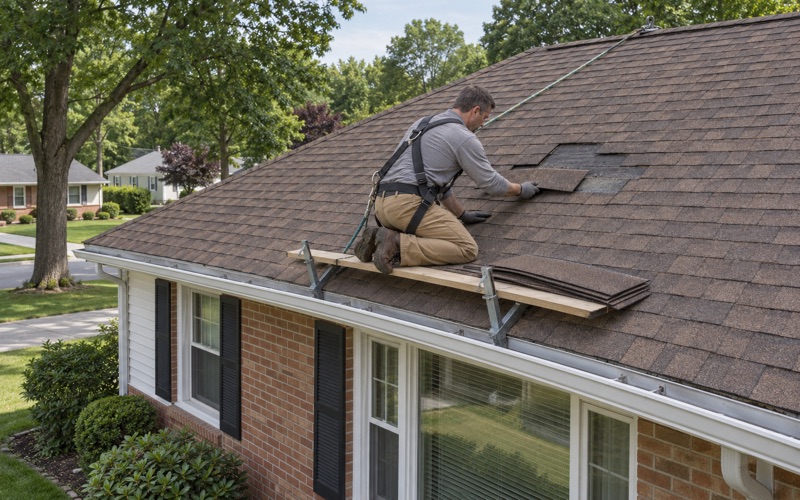
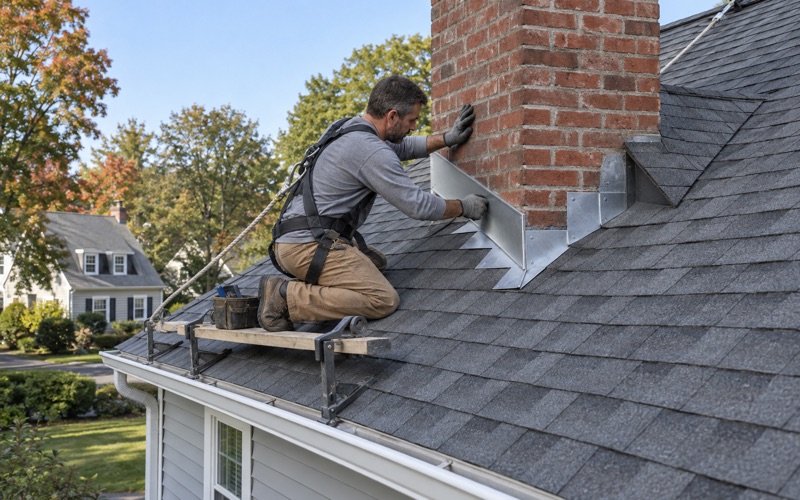
Edge work begins with drip edge at the eaves and rakes, fastened to the deck so it holds the shingle edge instead of fluttering beneath it. A dedicated starter strip with a factory sealant line runs along both edges, so the first course is bonded down rather than relying on cut shingles turned around. At the rakes, shingles are set tight to the metal and sealed where the manufacturer calls for it.
Ridge caps are the other weak point on an exposed roof, since they take wind from both slopes at once. We use cap shingles made for the product line and fasten them with the nail length the instructions specify. Where a ridge vent goes in, we pair it with caps the manufacturer approves for that vent rather than mixing parts.
Decking and Flashing Under the New Roof
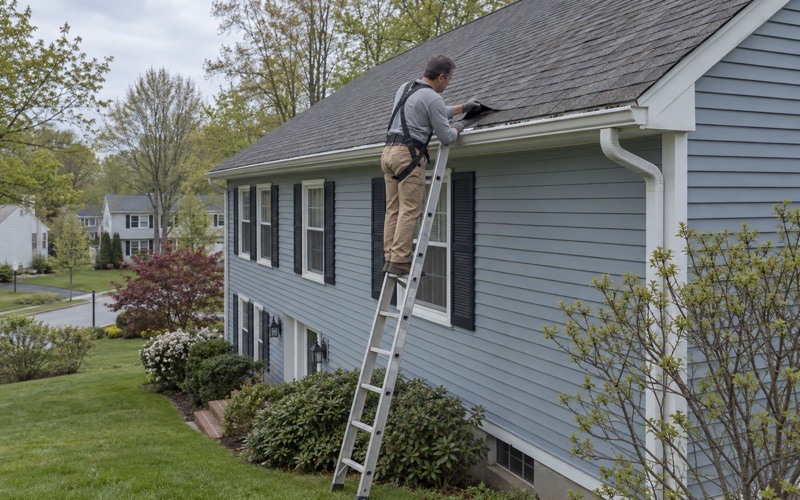
Fasteners hold only as well as the wood they go into. Once the old roof is off, any soft or delaminated decking is photographed and shown to you before it is replaced, at the per-sheet price already set in the contract. Step, counter and chimney flashing is replaced along with the roof instead of being reused, so the walls and edges of an exposed roof are not relying on old metal.
Attic ventilation is checked on every replacement as well. A ridge vent with soffit intake, balanced to the attic’s net free area, keeps heat and moisture from aging the deck and shingles. A roof that cannot breathe ages from underneath, which can undo careful edge work on any lot.
Two-Family Houses and the Borough’s Older Roofs
In East Rutherford, 33.3 percent of housing units sit in two-unit buildings, against 16.6 percent in one-unit detached houses, and 64.6 percent of households rent. That mix shapes roofing here more than any landmark does. A two-family house usually puts one roof over two households, and an owner’s unit can share it with a rented one.
Shared Roofs and Duplex Walls
Ordinance 2026-05, the zoning amendment the borough has posted, separates a conventional two-family house, with units divided by an unpierced ceiling and floor, from a duplex, divided by an unpierced wall running from the basement to the roof. For a roofer the difference is practical. A stacked two-family has one roof serving both units, while a side-by-side duplex has a dividing wall that meets the roof itself.
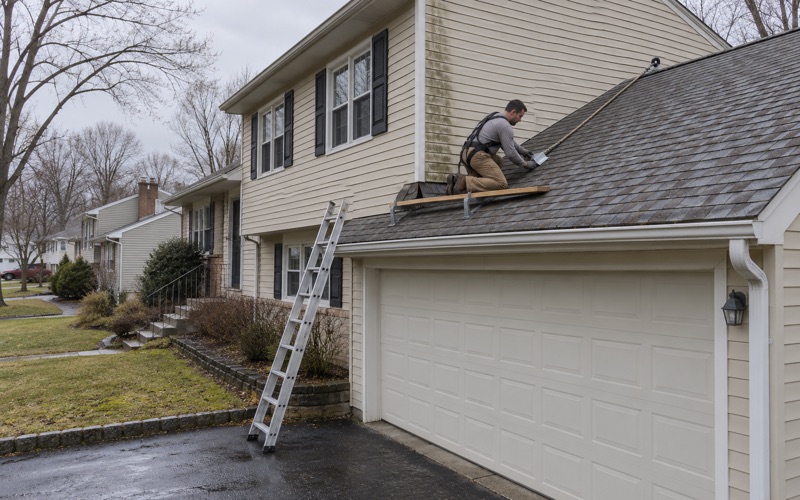
Before we write an estimate on a duplex, we confirm who holds each half of the roof and whether both sides are being done. Where only one side is replaced, we plan the tie-in at the dividing wall so the new half laps correctly with the old one and water has no seam to find.
Older Houses and Ice-Prone Eaves
Of the borough’s housing units, 22.4 percent were built before 1940, and another 28.8 percent date from the 1950s and 1960s. Houses of that age often carry more than one layer of roofing, and under the state rehabilitation subcode a roof with two or more existing layers is torn off rather than covered again. Painted fascia and trim on pre-1978 houses are handled under EPA lead-safe work practices when disturbed.
Older eaves that have built ice dams get an eave membrane, ASTM D1970 self-adhering ice and water barrier, along with a ventilation check rather than just new shingles. On an exposed lot, that membrane and a properly fastened drip edge work together, keeping both meltwater and wind-driven rain out of the same vulnerable edge.
Contracts, Storms and Daily Cleanup
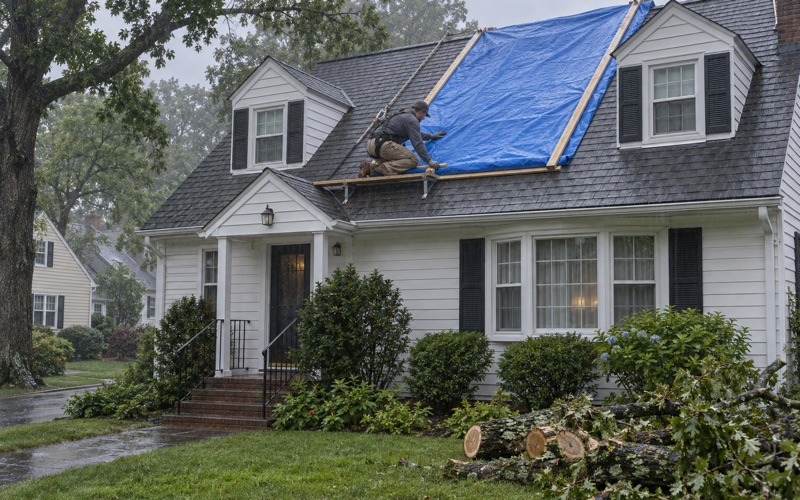
Every contract we write follows New Jersey’s home improvement rules, including notice of your three-business-day right to cancel. After a wind storm, we photograph damage before anything is moved and get tarps or temporary repairs on the same day. That documentation is written up for your own insurance claim, and we will meet the adjuster on site if you ask.
At the end of each work day the driveway, yard and gutters are cleaned, and a magnet sweep picks up loose roofing nails. On a two-family lot, where the same yard and walk serve two households, that daily cleanup protects more than one set of tires and feet.
- 20+ Years on Local Roofs
- Itemized Written Scopes
- Same-Day Storm Tarping