
Parsippany Elite Roofing handles flat roof repair in Parsippany, NJ and has worked on roofs throughout the area for more than 20 years, serving surrounding cities including Hanover, East Hanover, Denville, Florham Park and West Caldwell. Many homes here have at least one low-slope section: a porch roof, a rear addition, a dormer, an attached garage or a sunroom. Mixed-use buildings with apartments above a storefront often have a flat roof over the whole building.
Flat roofs fail differently from shingled roofs. Water drains slowly, seams carry more of the load, and the joint where the flat section meets a wall or a steeper roof is a frequent weak point. A good repair starts by understanding which of those is causing the problem.
We inspect the roof surface, the edges and drainage, and the area below where water is showing up. Then we explain whether a repair will hold or whether the roof is ready to be recovered or replaced, and we write the scope line by line.
Flat Roof Materials We Repair
EPDM Rubber Membrane
EPDM is a synthetic rubber membrane laid in large sheets, with seams joined by tape or adhesive. It stays flexible in the cold, which suits northern New Jersey winters. Its usual failures are seams that peel apart, shrinkage that pulls the membrane away from edges and walls, and punctures from debris or foot traffic.
We clean and prime the area, then repair seams and punctures with EPDM-compatible tape and patches. Where shrinkage has pulled flashing loose, we reattach or replace the perimeter flashing. Using compatible materials is essential, because mismatched patches simply peel off.
Modified Bitumen and Rolled Roofing
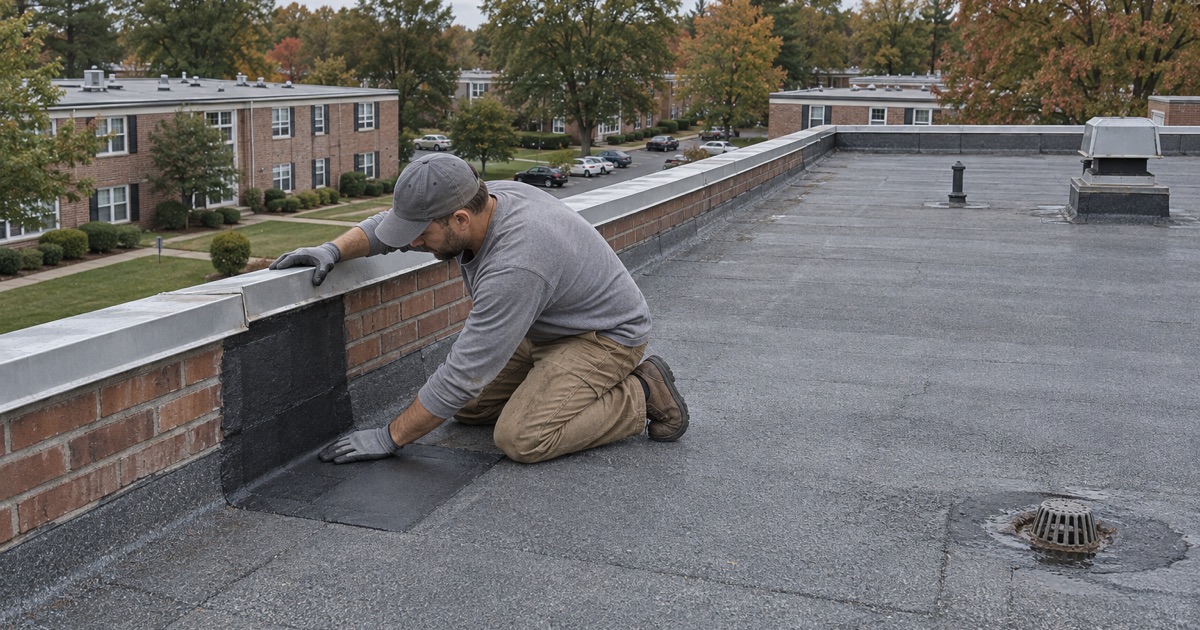
Modified bitumen is a multi-layer asphalt-based membrane, often installed with a torch, and rolled roofing is a simpler asphalt sheet common on older porches and garages. Both develop blisters, cracks and open laps as they age. Granule loss on the surface exposes the asphalt to sunlight and speeds up wear.
We cut out and patch blisters, reseal open laps and patch cracked areas with compatible material. Where the surface is worn across the whole roof, a patch will only buy a short time. We tell you when that is the case.
TPO and PVC Membranes
TPO and PVC are heat-welded single-ply membranes found on newer additions and many commercial buildings. Their welded seams are strong, but punctures, failed flashings and seams that were not fully welded can still leak. These membranes need heat-welded repairs to bond properly.
We weld patches of matching membrane over punctures and failed seams. Perimeter and wall flashings are checked and rewelded where needed. Each repair is probed after it cools to confirm a solid bond.
Where Flat Roofs Usually Leak
Wall and Roof Transitions
The joint where a flat roof meets a house wall or a steeper shingled roof is the most common leak point. Water running down the steep roof or the wall needs to be carried onto the membrane, not behind it. When the flashing at that joint fails, water runs straight into the wall or ceiling below.
We rebuild the transition with proper base and counter flashing. Where a shingled roof drains onto a flat one, the shingles and membrane are lapped so water always flows over the joint rather than into it. This detail is often the whole repair.
Seams and Laps
Flat roofs are made of sheets joined together, and every seam is a potential leak. Age, heat and movement can open seams, especially at corners and where the roof meets curbs or walls. Open seams often leak only when water ponds over them.
We inspect seams by hand and probe them for gaps. Failed seams are cleaned and resealed with material matched to the membrane. Where many seams are failing, a recover or replacement is usually more sensible than chasing them one at a time.
Drains, Scuppers and Edges
Flat roofs depend on drains, scuppers and gutters to carry water away. Leaves, needles and debris clog them, especially on wooded lots, and water then ponds on the roof. The edge metal where the roof drains into a gutter can also loosen or rust.
We clear drains and scuppers, check that water flows freely and repair or replace edge metal. Where ponding is a persistent problem, adding a scupper or tapered insulation may be needed. We explain those options with their costs.
Repair, Recover or Replace
Checking for Wet Insulation
Many flat roofs have insulation between the deck and the membrane. When water gets in, the insulation soaks it up, loses its value and holds moisture against the deck. A roof with wet insulation underneath cannot simply be patched on top.
We check for soft spots, take core samples where needed and look at the deck from below when possible. Those findings decide whether repair, recover or replacement is the right answer. You get the evidence, not just a recommendation.
When Replacement Makes Sense
A flat roof covered in patches, with cracks across the surface and leaks that keep moving, is near the end of its life. Replacing it allows the deck to be repaired, slope to be corrected and a new membrane to be installed with proper flashing. On a home, that work is usually done in one or two days.
When a flat section is replaced along with the main roof, the two are flashed together as one system. That eliminates the transition problems that cause so many leaks. The estimate lists both parts separately so you can see each cost.
- 20+ Years on Local Roofs
- Itemized Written Scopes
- Same-Day Storm Tarping