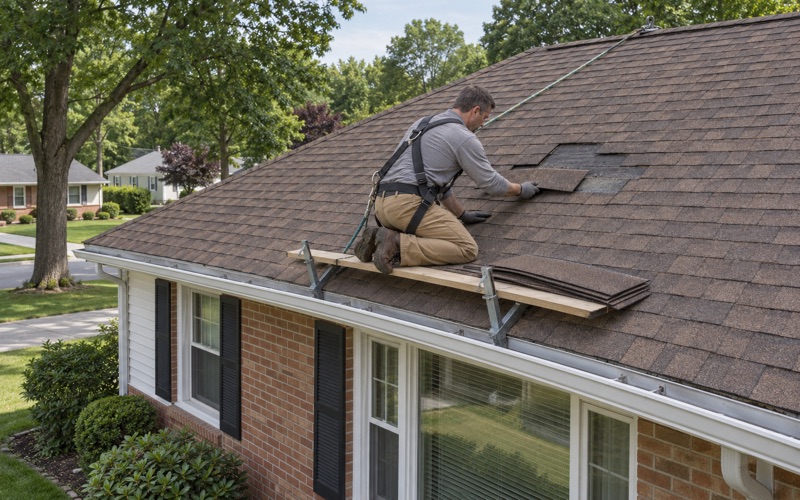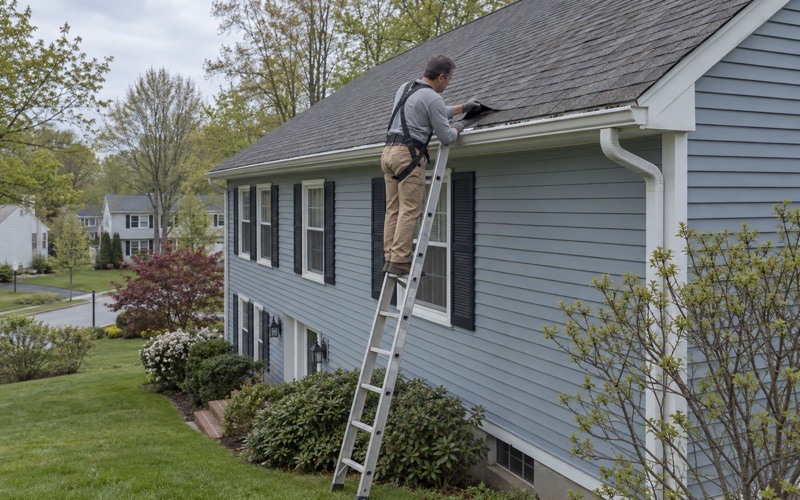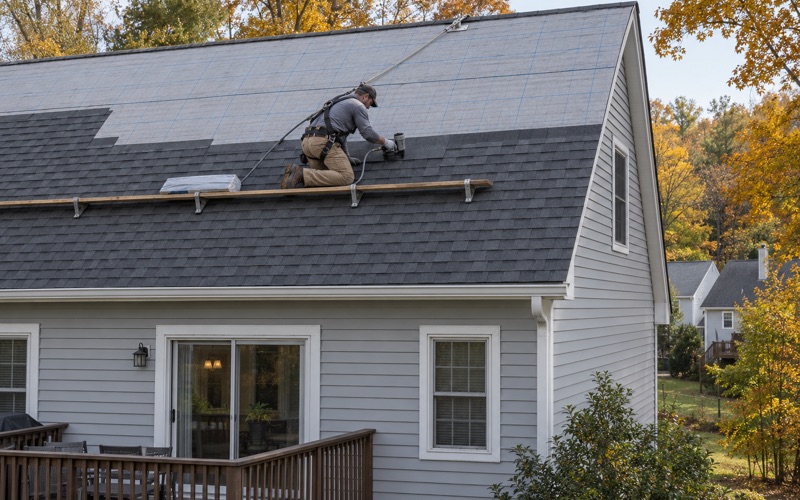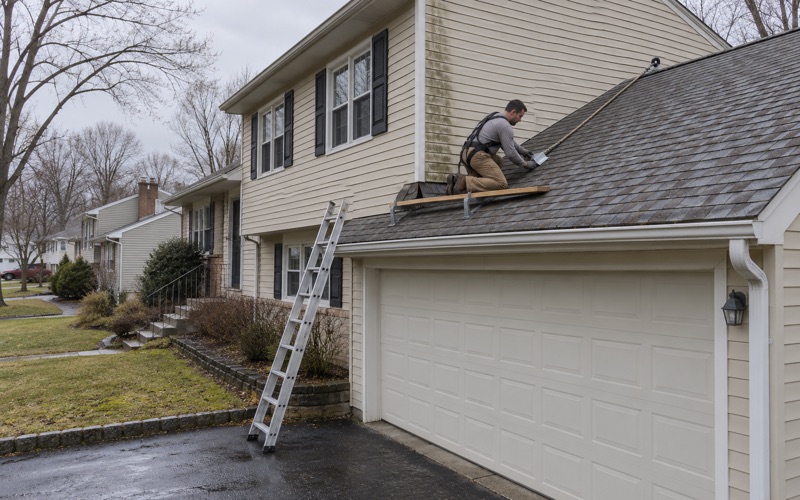
Parsippany Elite Roofing handles roofing in Hasbrouck Heights with more than 20 years in business behind every inspection, estimate and tear-off we write up. On a leak call we climb into the attic as well as onto the roof, because the stain on a ceiling is rarely directly under the spot where water gets through. Nothing is priced until that path is traced.
Most of the work here is on single-family houses, and most of the damage we are asked about comes from above the roof rather than from age alone. A heavy limb, a gutter torn loose by ice, a chimney flashing pried open by a falling branch: each of these can look like a full replacement from the driveway. We give a straight answer on whether the roof can be repaired before replacement ever comes up.
When a replacement is the right call, our written scope breaks tear-off, decking, underlayment, flashing, ventilation and gutters into separate lines. That lets a homeowner set our estimate beside anyone else’s and compare it item by item instead of total against total. The sections below explain why trees, more than snow on the roof itself, shape so much of what we look for on these houses.
The October 2011 Nor’easter in Hasbrouck Heights
Two Days Before Halloween
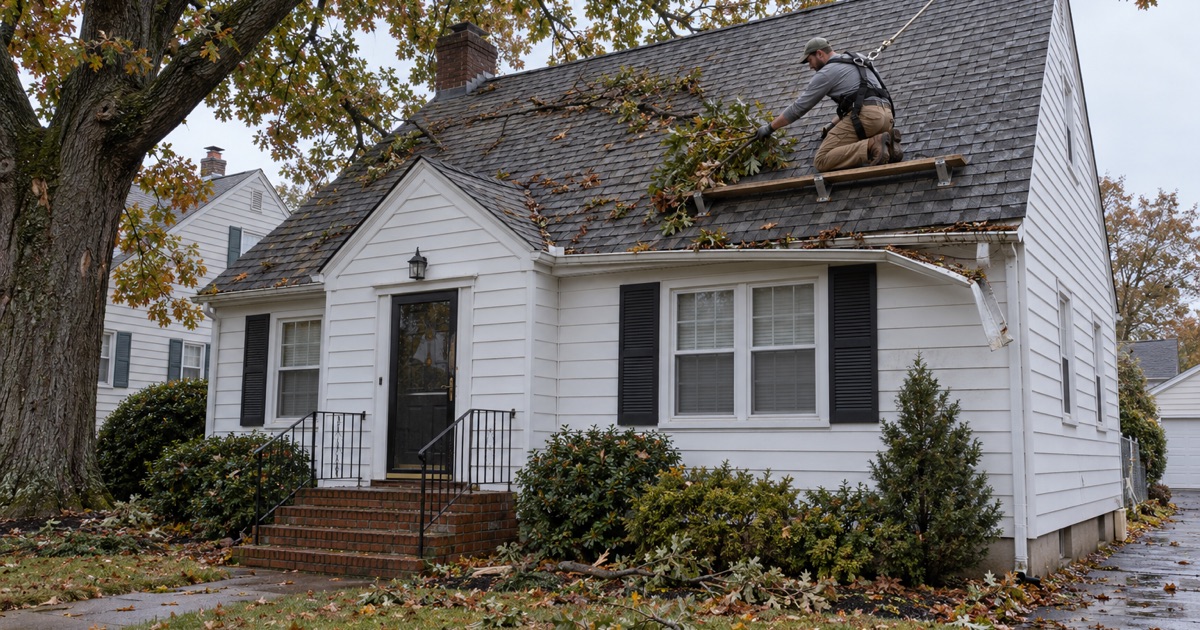
The nor’easter the borough remembers for its trees came on Saturday, October 29, 2011, two days before Halloween. Recalling it a year later, borough officials said the October 2011 storm took down trees and power lines all over the borough. Huge downed trees and branches closed streets, and several parts of town had no electricity for days.
That account came from a Patch preview written as Superstorm Sandy approached, and Sandy a year later brought its own reports of trees falling onto homes. But the 2011 storm was a different event with a different cause. We have found no snowfall total or house-damage count for Hasbrouck Heights from that storm, so we describe it by what it did to the trees.
Wet Snow on Trees Still in Leaf
The National Weather Service summary for that Saturday explains the mechanism. Heavy, wet snow fell while many trees throughout the region still had their leaves, and many trees and power lines bent and broke under the weight. By that afternoon, the summary reports tree and power line damage across northern New Jersey, helped along by strong winds.
A bare oak lets most snow fall through its branches, but a canopy in full leaf catches it like a net and holds it there. Wet snow is heavy for its depth, so a limb that would carry a January dusting can split in late October. That is why the risk to a roof from an early storm is a falling branch long before it is the weight of snow on the shingles.
Why We Inspect After Early Snow
Because the storm the borough remembers was a tree storm, the useful question after any early-season snow is what fell, and where. A branch that bounced off the roof and landed in the yard can still leave a cracked shingle tab, a dented gutter or a lifted flashing that will not leak until the next heavy rain.
Weather for the borough is forecast under the National Weather Service’s Eastern Bergen zone, issued from the Upton, New York office, so that is the forecast to watch when an October storm is on the way. When one is coming and the trees are still green, a quick look at which limbs hang over the roof is worth more than any amount of worrying about snow load.
Looking for roofing closer to Hanover? See Roofing in Hanover.
What a Falling Limb Does to a Postwar Roof
The Houses Under the Branches
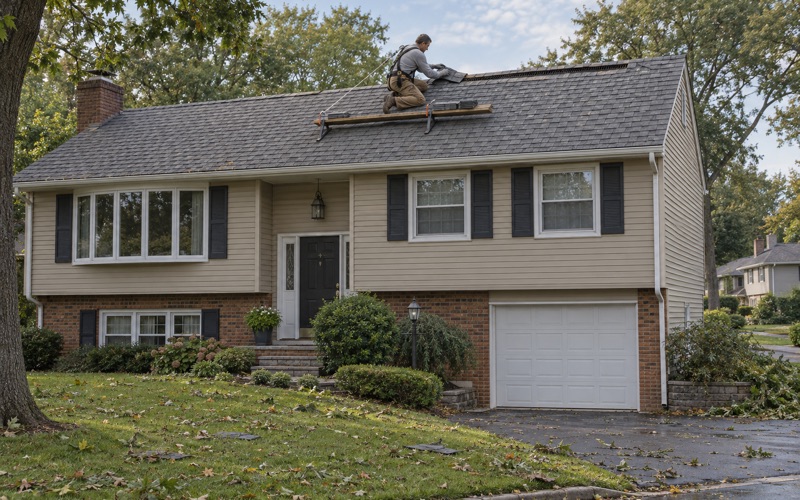
Hasbrouck Heights is a borough of older detached houses. According to the 2024 American Community Survey five-year estimates, 64.9 percent of homes are one-unit detached, 45.7 percent of housing units were built between 1940 and 1959, and another 21.1 percent date to 1939 or earlier. The 1950s alone account for 33.8 percent of the housing stock.
Those numbers matter after a storm because a house of that age has usually been re-roofed more than once, and the deck under it has carried every layer. Street and yard trees have had decades to grow out over those roofs. When a heavy limb comes down, it lands on decking and rafters that are often original to the house.
Deck, Rafters and the Attic Below
A limb strike rarely stops at the shingles. The impact can crack decking boards, split a rafter, or loosen nails that then back out and leak months later. That is why we go into the attic after any tree hit, looking for daylight, fresh splinters, wet insulation and staining along the rafters before we say anything about the roof outside.
If the damage is confined to a few courses and one or two boards, a section repair is often the honest answer. If the deck is soft across a whole slope, we say so and show why. On a full replacement, any damaged decking found once the old roof is off is photographed and shown to the owner first, then replaced at the per-sheet price written into the contract.
Layers and Ventilation on Older Houses
Older roofs here often carry more than one layer, and a branch that tears through two layers leaves a ragged hole that cannot be patched cleanly. New Jersey’s rehabilitation subcode calls for a tear-off where two or more layers are already in place, so a heavily damaged double-layer roof usually means stripping to the deck rather than shingling over.
We also check attic ventilation on every replacement, because a roof that cannot breathe ages from underneath no matter how good the shingles are. On a house built in the 1950s, the original soffit and gable vents can be painted shut or blocked by later insulation, and a ridge vent with proper soffit intake usually needs to be planned into the scope.
Gutters, Flashing and the Roof Edge After an Early Snow
Gutters Loaded With Leaves and Snow
An October storm finds gutters at their worst. Leaves are already packed in the troughs by late October, and wet snow sitting on top of them adds weight the hangers were never meant to carry. A falling branch that clips the eave can then rip a run of gutter loose and bend the drip edge with it.
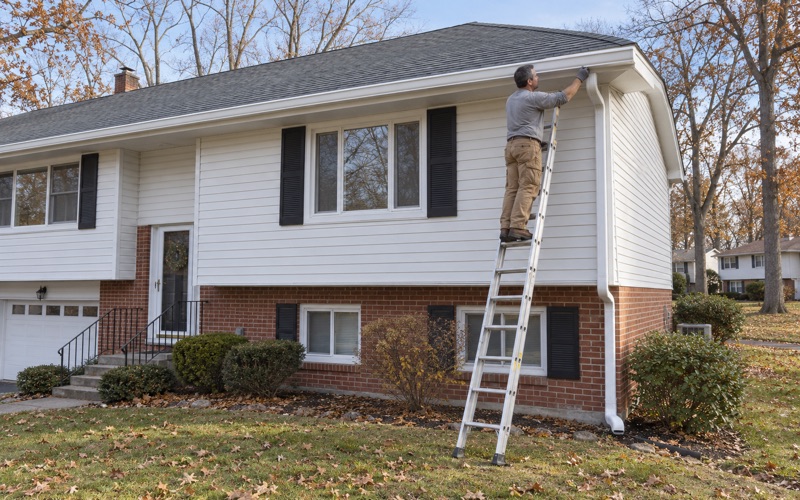
After an early snow we walk the full roof edge, not just the section under the fallen limb. We look for hangers pulled out of the fascia, seams split at the corners, and leaders crushed or disconnected at the ground. Where a new run is needed, seamless aluminum gutters are listed as their own line in the estimate so you can see exactly what that part costs.
Flashing Where Branches Hit Hardest
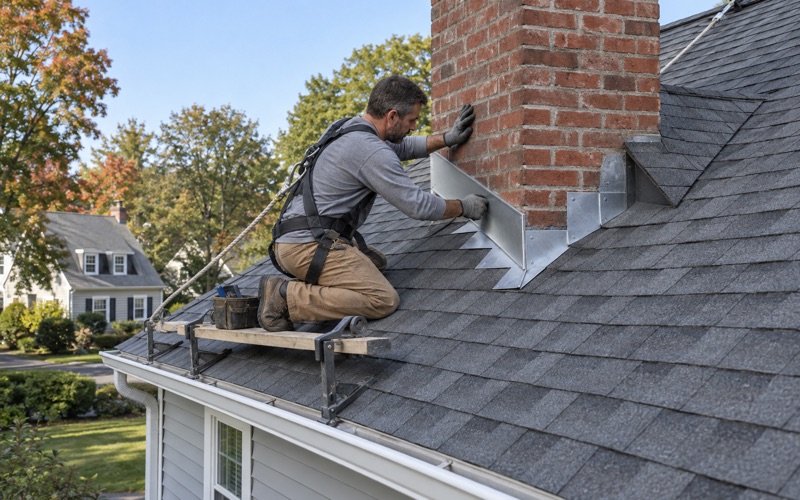
A falling branch often catches on whatever rises above the roof plane. Chimneys, dormer walls and the line where a porch roof meets the house all carry step, counter or apron flashing that a limb can pry open without visibly damaging a single shingle. Water then runs behind the siding or down the inside of the chimney.
This is often where the attic look pays for itself, since the stain from a pried flashing can show up well away from the chimney. When we replace a roof, step, counter and chimney flashing are replaced with it rather than bent back and reused under new material. A chimney wider than 30 inches also needs a cricket behind it to keep snow and leaves from piling up.
Painted Fascia and Trim
Repairing the roof edge after a limb strike often means removing and replacing painted fascia or rake trim. Of the borough’s 4,597 housing units, 4,185 were built before 1980, so many houses are old enough that the federal EPA lead-safe renovation rule for pre-1978 homes has to be considered before that paint is disturbed. The rule treats exterior work disturbing 20 square feet or less of painted surface as minor repair, but a long run of fascia can pass that quickly.
Trimming Over the Roof Before the Next Early Storm
Which Limbs Deserve Attention
The limbs worth worrying about are the ones that reach over the roof, especially heavy horizontal branches on mature trees close to the house. A storm does not need to be historic to bring one down. On May 5, 2026, a large limb fell onto a house and a car on Lincoln Avenue, and the borough’s fire department responded, with no storm described at all.
Wooded lots are something we plan for rather than discover. When overhanging limbs, leaf-packed valleys or shaded slopes that hold moss are part of the picture, we call them out in the estimate so the owner can arrange trimming with a tree service before the crew arrives. Cutting back limbs before October is one of the cheapest protections against the next early storm.
Same-Day Tarps After a Storm
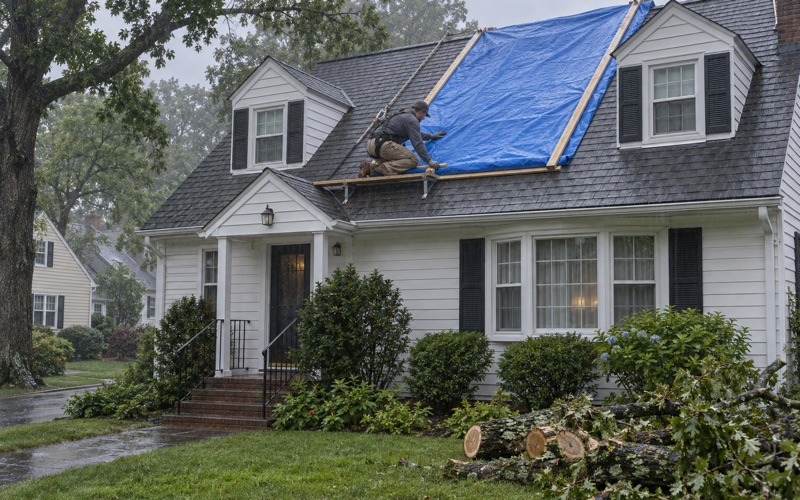
When a branch does come through, the first goal is keeping water out of the house. After a wind storm we put tarps and temporary repairs on the same day, and we photograph the damage before anything is moved, including the limb itself if it is still on the roof. Those photos are often the clearest record an owner will have later.
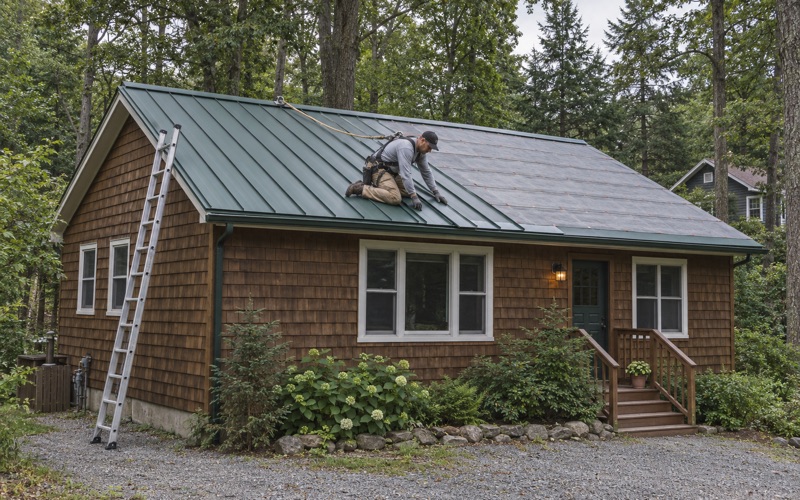
Safety comes before speed on a roof that has just taken a hit. Federal OSHA rules call for fall protection at 6 feet on residential roofing work, and a slope with a broken deck or a limb still lying across it is no place to cut corners. If the tree needs to come off first, we wait for it.
Writing It Up for Your Own Claim
Tree damage often ends up as an insurance question, and the claim belongs to the homeowner. We photograph the damage and write it up so the owner has a clear record to submit, and when asked, our crew will meet the insurance adjuster on site to walk the roof. What the policy covers is between the owner and the insurer, and we do not predict the outcome.
Any repair or replacement contract we write follows New Jersey’s home improvement rules, including the three-day cancellation notice, so an owner deciding under storm pressure still has time to reconsider. At the end of each work day the driveway, yard and gutters are cleaned, with a magnet sweep for nails. That matters most on a narrow lot where cars and children share the driveway with the crew.
- 20+ Years on Local Roofs
- Itemized Written Scopes
- Same-Day Storm Tarping