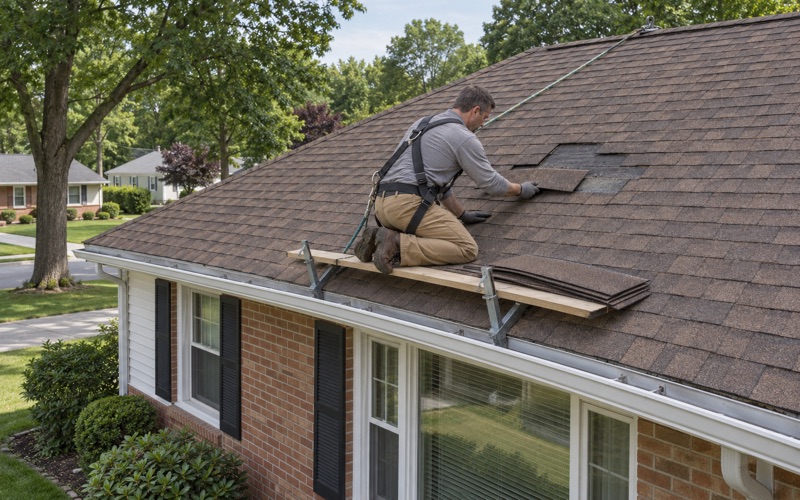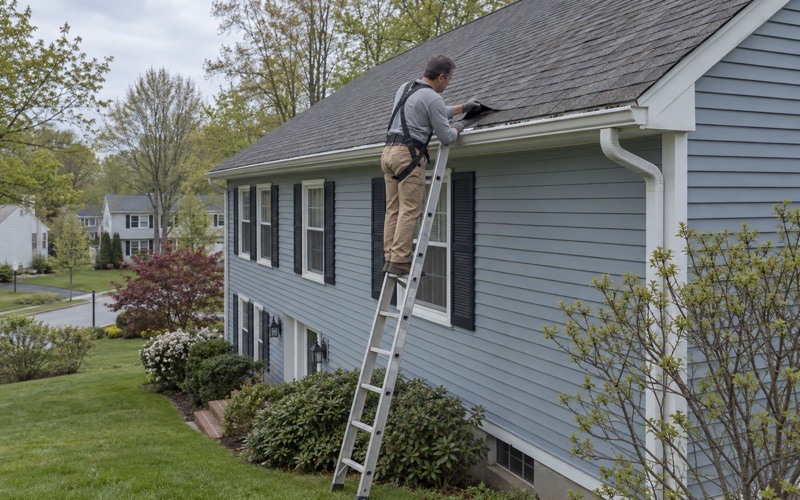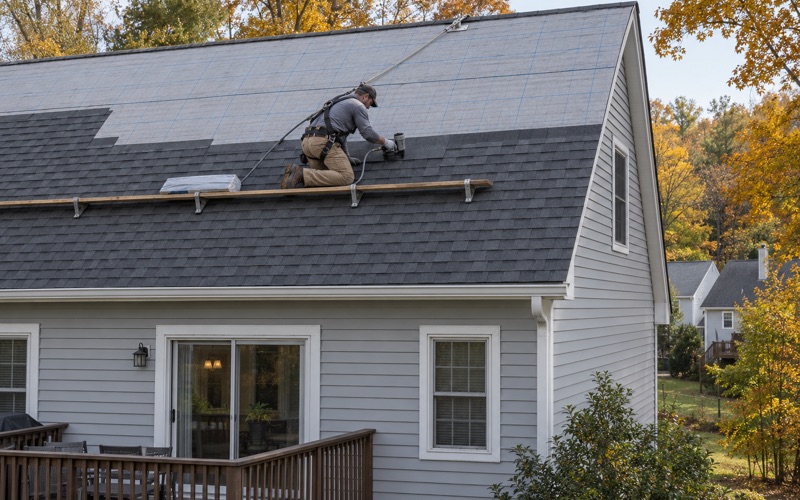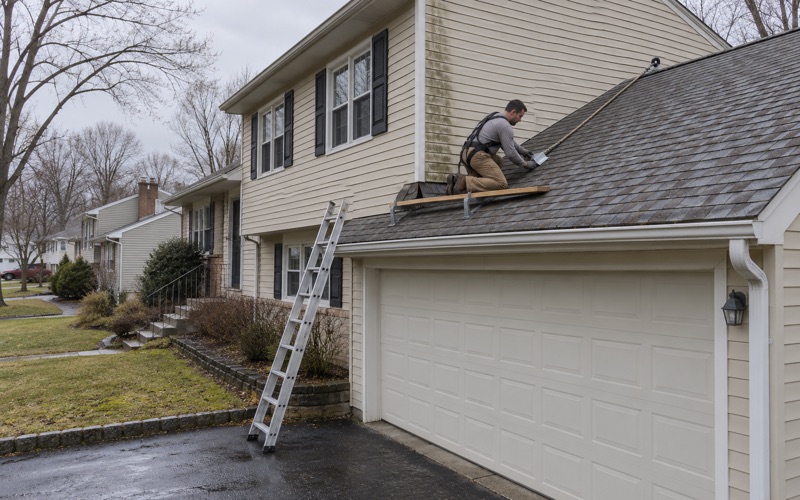
Parsippany Elite Roofing has spent more than 20 years on roofing in Oakland and across this part of North Jersey, and many of the calls we take from the borough start the same way: wind came through, something hit the roof, and the owner wants to know how bad it is. We answer that question with a ladder, a flashlight and a camera before we talk about price.
The first thing we settle is whether the roof needs a repair or a replacement, and we tell you plainly which one it is before a new roof is ever mentioned. A few lifted shingles and a cracked pipe boot do not justify a tear-off, and we will not write one up as if they did. When the damage really is past repair, the estimate shows why, line by line.
This page covers the kind of weather damage Oakland roofs actually see, how we inspect a postwar house after a storm, and how we document what we find so you have a clear record for your own insurance claim. If a storm has just passed and water is coming in, call us first and read the rest later.
July 10, 1989: The Oakland to Franklin Lakes Tornado
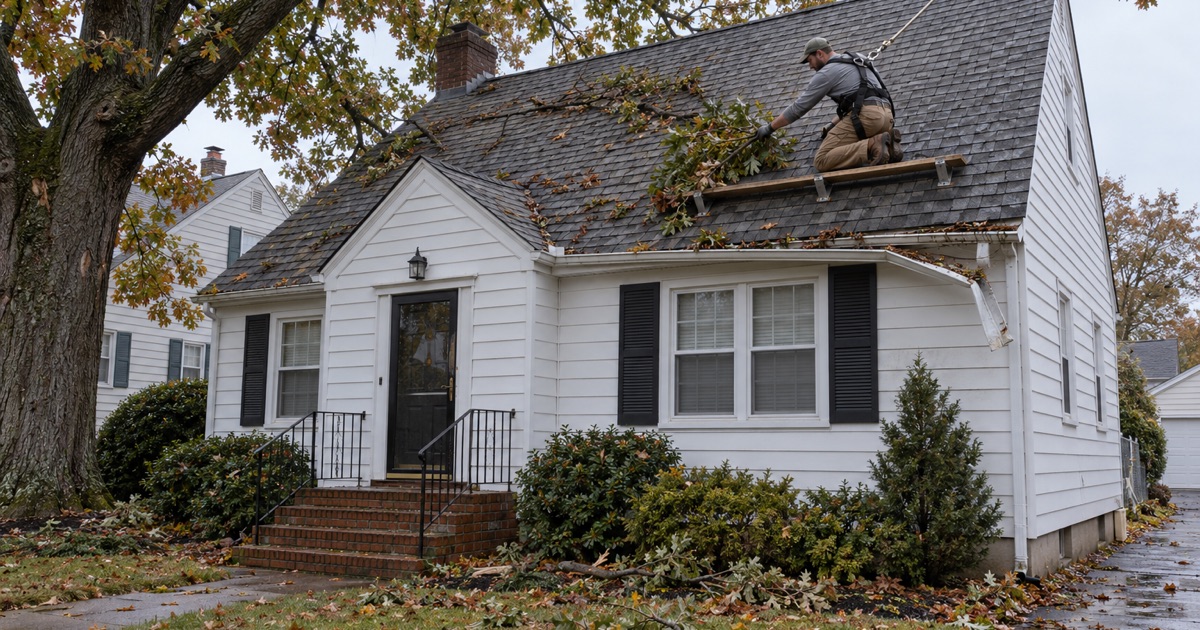
Oakland has one recorded tornado, and it is worth knowing about because it shows what wind damage here usually looks like. On July 10, 1989, a Northeast outbreak produced 17 confirmed tornadoes, and one of them touched down in Oakland and tracked about 3.5 miles into Franklin Lakes. The record lists it as an F0 and describes the result in four words: tree and house damage.
What the Record Does and Does Not Say
The outbreak table we rely on gives the rating, the date, the path from Oakland to Franklin Lakes and its 3.5-mile length. It gives no width, no wind speed, no street names and no count of houses hit, so we do not repeat figures the record does not hold. That restraint is the same one we apply to your own roof: we report what we can see and photograph, not what someone remembers.
F0 is the weakest rating on the original Fujita scale, the one in use in 1989. It sits at the end of the range where the damage looks much like what a hard summer thunderstorm leaves behind, which is why the lesson of that day applies to ordinary storms every year.
What an F0 Does to a Roof
Weak tornadoes and straight-line winds damage roofs in the same few ways. Shingle tabs lift and crease, breaking the factory sealant strip that holds them flat, and the next gust can peel them off entirely. Ridge caps and the first course at the rakes go first, because that is where wind gets underneath. Drip edge can bend, and loose debris skids across the surface and scuffs away granules.
None of that looks dramatic from the driveway, which is the problem. A creased tab can sit in place for months while water works under it, and the first sign is often a stain on a bedroom ceiling the following winter. That is why we treat any high-wind event as a reason to look, not just the ones that make the news.
Wind Ratings on Replacement Shingles
When a wind-damaged roof does need replacing, we specify shingles tested to ASTM D3161 Class F or ASTM D7158 Class H, the two common wind-resistance standards for asphalt products. Architectural shingles such as GAF Timberline HDZ, Owens Corning Duration and CertainTeed Landmark are sold with those ratings, and the rating depends on installing them to the manufacturer’s nailing pattern, which we follow at every course.
Looking for roofing closer to Roselle Park? See Roselle Park Roofing.
Trees, Limbs and the Roofs Under Them
The 1989 record lists tree damage alongside house damage, and the two usually arrive together. Ramapo Mountain State Forest lies inside the borough, reached from Skyline Drive just north of the Interstate 287 interchange, and wooded lots are part of how Oakland looks. Wherever mature trees stand over a house, a strong storm turns limbs into the main threat to the roof.
Impact Damage from Limbs
A falling limb does not always punch a hole. More often it fractures shingles, cracks the decking beneath without breaking through, or knocks a gutter loose and bends the drip edge. A heavy limb that lands flat can also split a rafter, which shows up as a dip in the roofline or a cracked board visible from the attic.
We check the strike point from both sides. On the roof we lift the surrounding shingles to see whether the nails pulled through and the deck flexed, and in the attic we look for fresh splits, daylight and wet sheathing. A strike that looks cosmetic from outside sometimes turns out to need a sheet of decking, and the photographs show you why.
Same-Day Tarps and Temporary Repairs
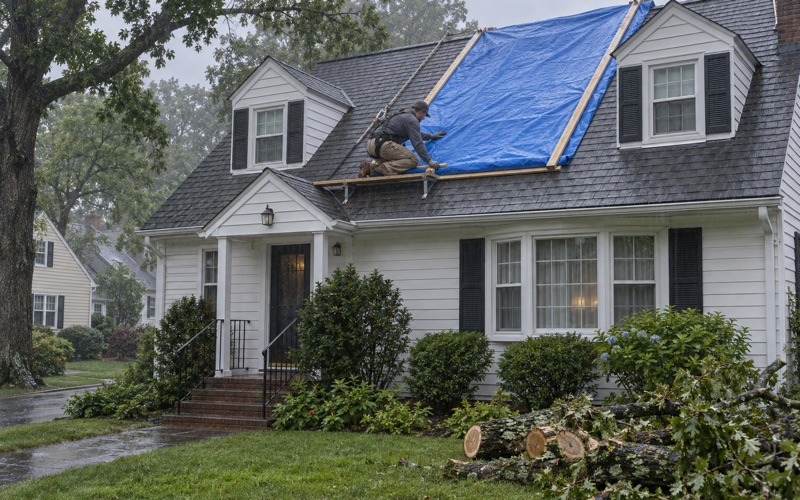
After a wind storm, an open roof cannot wait for a full estimate. We put tarps and temporary repairs on the same day, and before anything is moved, we photograph the limb where it landed, the damage around it and the interior where water came through. Once the tree is off the house, those first pictures are the only record of how it sat.
Large limbs resting on a roof are a job for a tree crew, and we coordinate around their work rather than climbing under a loaded branch. Our part is to make the opening watertight, protect the attic and keep the damage from spreading until the permanent repair can be priced and scheduled.
Overhanging Limbs and Leaf-Packed Valleys
Not every tree problem arrives in a storm. Branches that rest on or sweep across shingles grind the granules off over time, valleys fill with leaves that hold water against the underlayment, and shaded slopes grow moss that lifts tab edges. On wooded lots our estimates call these conditions out by name, so you can decide what to trim or clear before the next high wind finds them.
Checking a 1950s or 1960s Roof After High Wind
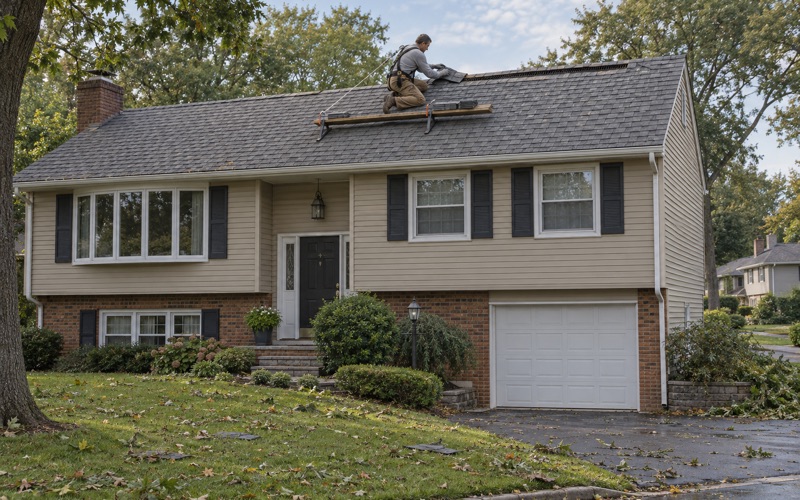
Oakland was built in one burst. The census counted 1,817 residents in 1950, then 9,446 by 1960 and 14,420 by 1970, and the latest five-year American Community Survey dates 63.1% of the borough’s homes to the 1950s and 1960s. Houses of that era tend to be ranches, split-levels and Cape Cods, and their roofs share a few weak points when the wind picks up.
We Start in the Attic
Every storm call includes a look in the attic as well as on the roof. On a ranch or a split-level, the attic tells us quickly whether water got past the shingles, whether the decking shifted under an impact, and whether a leak is coming from the storm or from something older, like a tired pipe boot or a rusted chimney flashing.
That distinction matters for your claim as much as for the repair. Storm damage and age-related wear are different things, and a report that mixes them up is harder for everyone to use. We trace the water to where it actually enters before anything is priced, and we say plainly which damage we believe the wind caused and which was already there.
Lifted Tabs, Ridges and Rakes
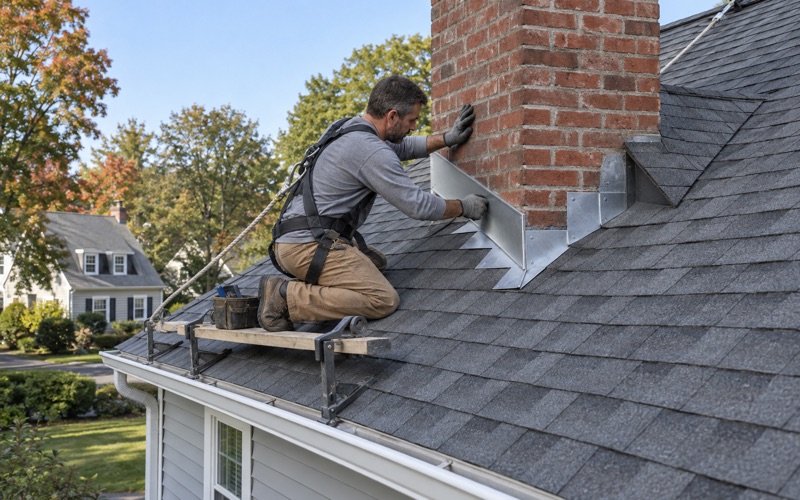
Up top, we hand-check shingle tabs along the windward slopes, the ridge and both rakes, because a tab that has lost its seal often lies flat until you lift it. We look for creases across the tab, missing granules in a line, nails backed out of the course above, and ridge caps that have cracked or shifted.
Older Cape Cods and split-levels add their own trouble spots. Dormer walls and the joints where a split-level’s roofs meet a wall depend on step flashing and counter flashing, and wind-driven rain finds any gap there. Eaves on these houses are also where ice dams tend to form in winter, so we note their condition while we are up there.
Repair, or Time for a New Roof
If the storm caught a roof with plenty of life left, a repair is usually the right answer, and we will say so. If the shingles were already brittle or the roof has two layers, a patch may not hold, and we explain why in plain terms. Under New Jersey’s rehabilitation subcode, a re-roof over two or more existing layers calls for a full tear-off.
When we do replace, the written scope lists tear-off, decking, underlayment, flashing, ventilation and gutters on separate lines. Rotten or cracked decking found under the old shingles is photographed and shown to you before it is replaced, at the per-sheet price written into the contract, and step, counter and chimney flashing is replaced with the roof rather than reused. We also check attic ventilation on every replacement, since a roof that cannot breathe ages from underneath.
Documenting Storm Damage for Your Carrier
After a storm, the record you build in the first few days often matters as much as the repair itself. We photograph and write up storm damage for your own claim. You deal with your insurance company directly; our job is to give you an accurate account of the roof to bring to that conversation.
Photos Before Anything Moves
Our photographs start at the street and work inward: the whole roof from each side, then each damaged area at a distance and up close, with something in frame for scale. Lifted tabs are shown lifted, limb strikes are shown with the limb still in place when it is safe, and interior stains are shot alongside the attic area above them.
Dates matter too. Oakland sits in National Weather Service forecast zone NJZ103, Western Bergen, served by the Upton office, so we note the date of the storm and the zone it fell in. That gives your carrier a clear way to match the damage to the weather event you are reporting.
A Written Report You Keep
The photographs go into a written report that describes each item, where it is on the roof, what we believe caused it and what it would take to fix. It is written for you, and you decide who sees it. Repairs and replacement are priced separately on their own estimate, line by line, so the two documents never blur together.
We make no promises about coverage, because that decision belongs to your policy and your carrier. The New Jersey Department of Banking and Insurance publishes guidance for homeowners filing storm claims, and it is worth reading before you call. Your deductible and what your policy covers are questions for your agent, not for a roofer.
Meeting the Adjuster, Then Doing the Work
When you ask, our crew will meet the insurance adjuster at the house and walk the roof with them. We point out what we found and show the photographs and attic evidence behind it, and the adjuster makes their own assessment. Having the person who inspected the roof on the ladder at that visit tends to make the conversation shorter and clearer.
Any repair or replacement contract we write follows New Jersey’s home improvement rules, including the notice of your right to cancel within three business days. At the end of each work day we clean the driveway, yard and gutters and run a magnet sweep for nails, which matters on a lot where children and pets will be back outside by evening.
- 20+ Years on Local Roofs
- Itemized Written Scopes
- Same-Day Storm Tarping