
Parsippany Elite Roofing has completed roof replacement in Parsippany, NJ for more than 20 years, serving surrounding cities including Hanover, East Hanover, Denville, Florham Park and West Caldwell. Before replacement is ever discussed, we check whether the roof can still be repaired. When it cannot, we explain why with photos from the roof and the attic, and the decision stays with you.
A new roof is more than a fresh layer of shingles. The decking underneath, the flashing at every wall and chimney, the ice barrier at the eaves, and the ventilation that keeps the attic dry all decide how long the new roof will last. We treat each of those as part of the job instead of an optional extra.
Every estimate we write lists the work line by line: tear-off, decking, underlayment, flashing, ventilation and gutters. That makes it easy to compare our price with another company’s and to see exactly where the money goes. Nothing is bundled into a vague single number.
What a Full Roof Replacement Includes
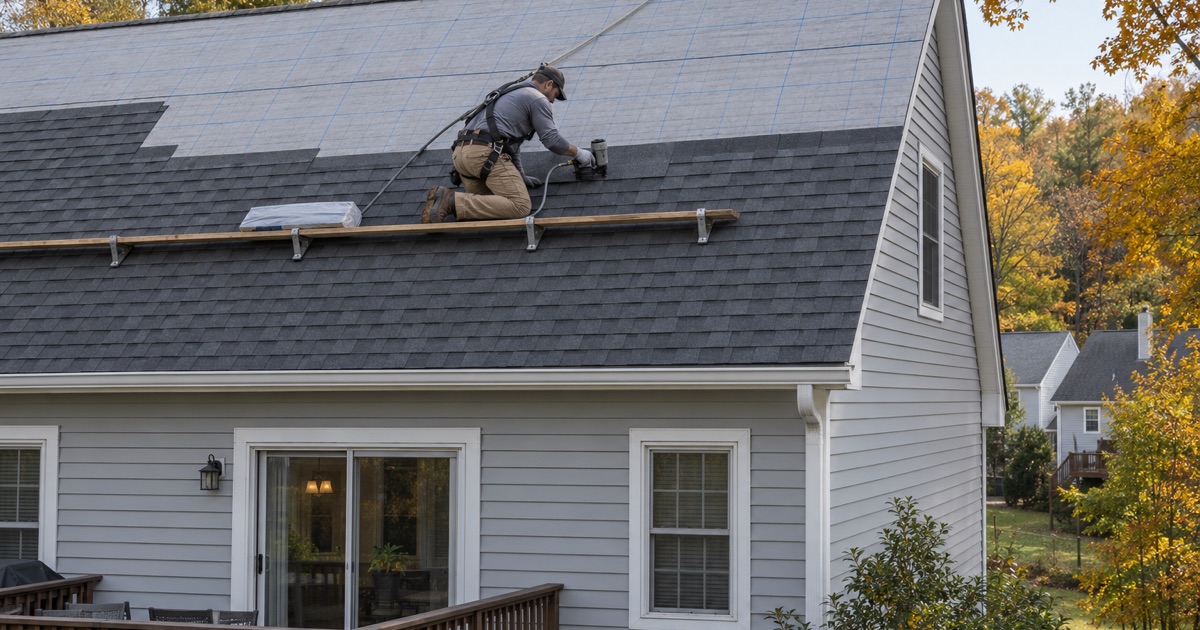
Complete Tear-Off Down to the Deck
We remove the old shingles, underlayment and flashing down to the bare sheathing. New Jersey’s rehabilitation subcode requires a tear-off when there are already two or more layers, or when the old covering is slate, wood shake or tile. Even on a single-layer roof, removing everything lets us find problems that a roof-over would hide.
Tear-off day is also when we protect your property. Tarps cover shrubs and landscaping, debris goes straight into a dumpster or truck, and gutters are cleared as we go. By the end of the day the roof is closed up and the yard is cleaned.
Decking Inspection and Replacement
With the old roof off, every sheet of decking is visible. We walk the deck, mark any soft, rotted or delaminated boards, and photograph them before anything is replaced. You see the damage yourself rather than taking our word for it.
The per-sheet price for replacement is written into the contract before work begins. That way, the cost of hidden damage is known in advance and is not open to negotiation on the day. We replace only what actually needs it.
Underlayment and Ice Barrier
New underlayment goes down over the entire deck. We use synthetic underlayment that meets ASTM D8257, and a self-adhering ice and water barrier that meets ASTM D1970 along the eaves, in valleys and around penetrations. On older capes and split-levels prone to ice dams, the eave membrane is one of the most important parts of the new roof.
In Sussex County, New Jersey’s ice barrier requirement applies because of the colder January average named in the state’s DCA Bulletin 07-3. Elsewhere in the area, we install eave membrane as standard practice because ice dams are common. Either way, the protection goes where meltwater would otherwise back up under the shingles.
Flashing, Ventilation and Edges
New Flashing at Every Wall and Chimney
We replace step flashing, counter flashing and chimney flashing with the roof instead of reusing old metal under new shingles. Old flashing is often bent, rusted or nailed in ways that no longer seal. Reusing it is one of the most common reasons a new roof leaks in its first year.
Chimneys wider than 30 inches get a cricket on the uphill side to divert water, as the residential code requires. Kick-out flashing goes at the bottom of every roof-to-wall joint, and apron flashing finishes the base of front walls. Each detail is lapped so water runs off by gravity rather than depending on sealant.
Balanced Attic Ventilation
A roof that cannot breathe ages from underneath. We check every replacement for soffit intake and ridge or other exhaust ventilation, and we look for insulation that has blocked the soffits. Where ventilation is missing or unbalanced, we include the fix in the scope.
Good ventilation keeps the attic closer to outdoor temperature. That reduces ice dams in winter, lowers heat buildup in summer and helps prevent condensation that rots decking. It also protects the shingle warranty, which often depends on proper ventilation.
Drip Edge, Starter Course and Ridge Cap
Drip edge at the eaves and rakes keeps water from running behind the gutters and into the fascia. A proper starter course along the eaves and rakes seals the first row of shingles against wind uplift. Ridge cap shingles finish the top of the roof and cover the ridge vent.
These details are small, but they are where wind damage usually starts. A roof that loses shingles along one rake every storm often has a missing or poorly installed starter course. Getting them right on day one prevents those repeat calls.
Choosing Roofing Materials
Architectural Asphalt Shingles
Most homes in Parsippany and nearby towns are reroofed with architectural shingles, which are thicker and more dimensional than older three-tab styles. We install GAF Timberline HDZ, Owens Corning Duration and CertainTeed Landmark among others. Each carries a Class A fire rating under ASTM E108 and UL 790.
Wind resistance is tested under ASTM D3161 Class F or ASTM D7158 Class H, depending on the product. For homes exposed to hail or falling limbs, impact-rated shingles tested to UL 2218 Class 4 are an option. We help you compare colors and profiles that suit the house and the street.
Metal, Slate-Look and Other Options
Some owners prefer standing seam metal roofing for its long service life and clean look. Others with older homes want the appearance of slate without the weight, and synthetic slate-look shingles fit that need. We explain the differences in cost, weight and maintenance so the choice suits your home.
Low-slope sections over porches, additions and garages often need a different material, such as modified bitumen or EPDM membrane. We include those areas in the same scope so the whole roof is replaced together. Transitions between steep and low-slope sections are flashed as one system.
Gutters With the New Roof
A new roof is a good time to look at the gutters. If they sag, leak at the seams or pull away from the fascia, replacing them with seamless aluminum gutters and leaders at the same time often makes sense. Gutters are listed as a separate line on the estimate, so you can decide.
When gutters stay, we protect them during tear-off and clean them at the end. Drip edge is fitted to direct water into them properly. Either way, the roof and gutters are designed to work together.
Our Step-by-Step Roof Replacement Process
Step 1: Inspection and Written Scope
We inspect the roof and attic, take photos and write an itemized scope. You see each line, from tear-off to ventilation. The contract follows New Jersey’s home improvement rules, including the three-day cancellation notice.
Step 2: Scheduling and Preparation
We order materials, confirm the dumpster and schedule around the forecast. If solar panels need to come off, the removal and reinstall are booked with the solar company in advance. Townhouse and condominium owners get an extra check of who holds the roof under the association’s documents.
Step 3: Tear-Off, Deck Repair and Installation
The crew removes the old roof, repairs the decking and installs the underlayment, flashing, shingles and ventilation. The roof is closed up at the end of each day. Any decking replaced is photographed and billed at the contract price.
Step 4: Cleanup and Final Walkthrough
We clean the gutters, yard and driveway each day, including a magnetic sweep for nails. At the end, we walk the job with you and review the photos. You receive the warranty paperwork and a record of what was installed.
- 20+ Years on Local Roofs
- Itemized Written Scopes
- Same-Day Storm Tarping