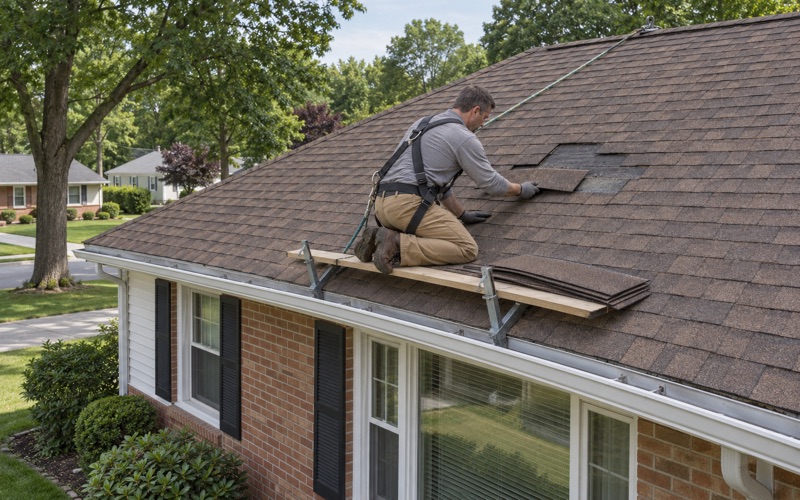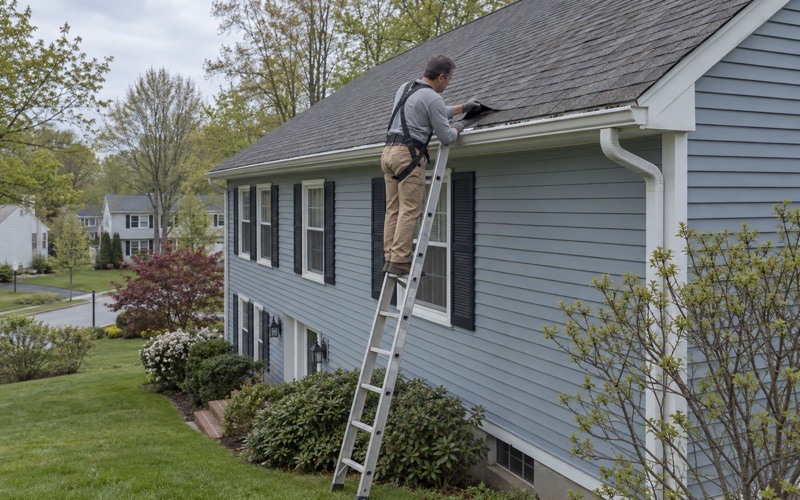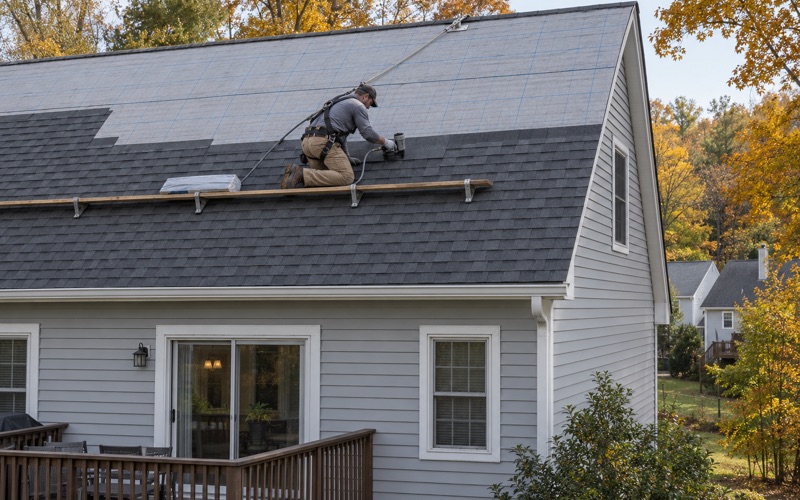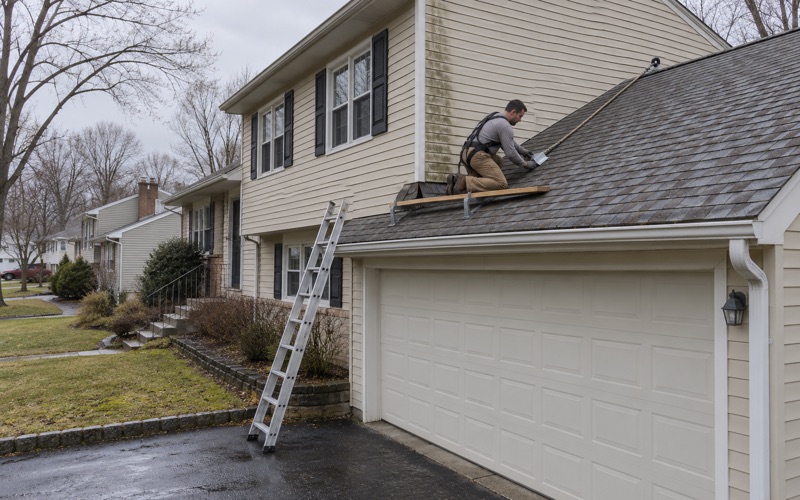
Parsippany Elite Roofing brings more than 20 years of work to roofing in Roselle Park, and every leak call starts the same way: a look at the roof surface and a look inside the attic, so the water is traced to where it actually enters before anything gets a price. If the roof can be repaired, we say so plainly before replacement comes up at all.
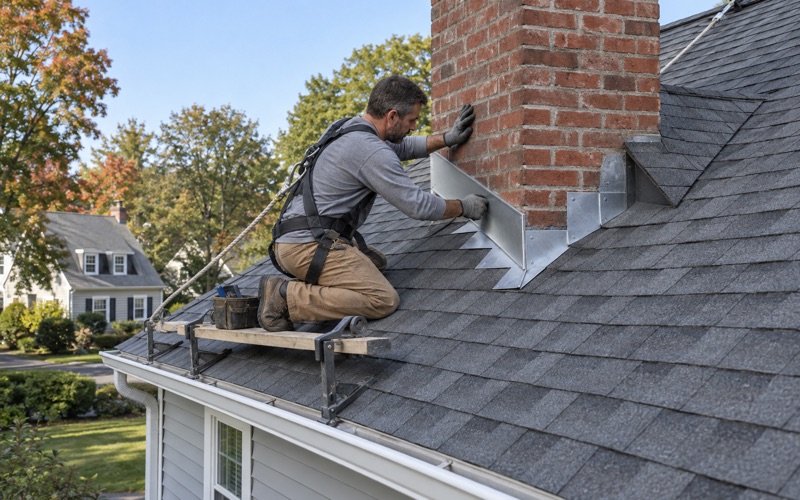
When a replacement is the right answer, the written scope breaks tear-off, decking, underlayment, flashing, ventilation and gutters into separate lines. That lets you lay two estimates side by side and compare them item by item instead of guessing at a single total. Step, counter and chimney flashing are replaced with the roof, never reused under new shingles.
The question that can shape a re-roof here is not the shingle line but the tree beside the house. Taking a whole tree down is a borough decision with its own paperwork, and we plan the roof around that answer rather than discovering it with a crew on the driveway. The sections below explain how that works and where we fit into it.
Trees Over Roselle Park Roofs
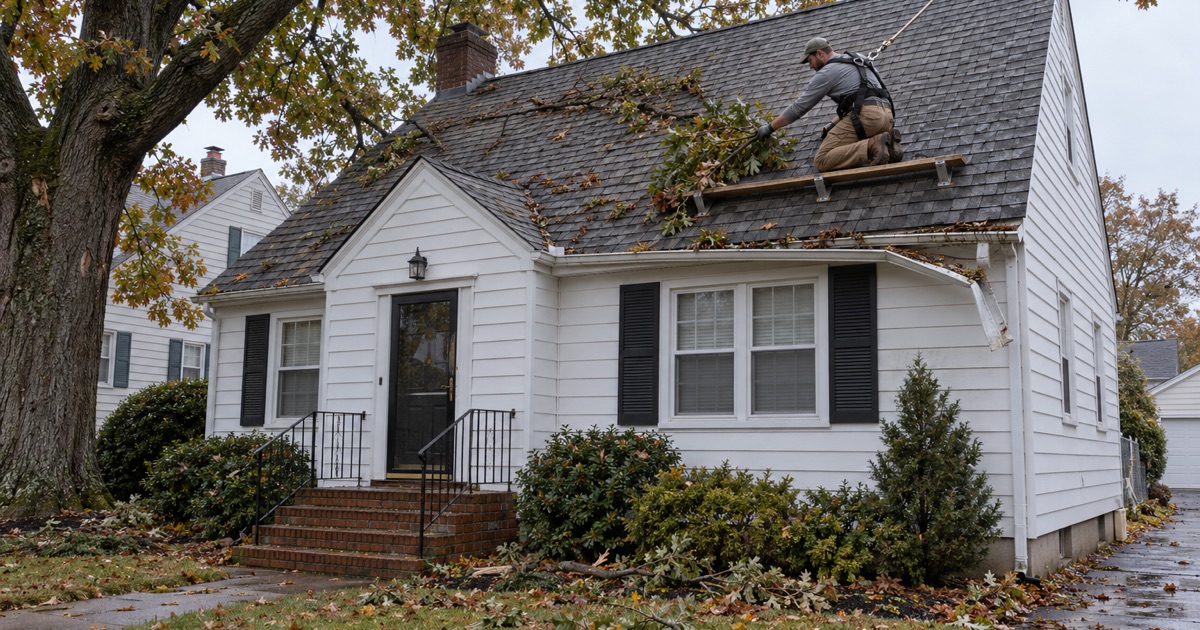
Roselle Park is a compact borough of 1.225 square miles with no water area, and its houses are old. Census figures date 1,547 of its 5,522 housing units to 1939 or earlier and another 1,050 to the 1940s, with a median year built of 1952. Houses of that age often sit beside trees planted decades ago that now reach over the shingles.
What a Mature Tree Does to a Roof
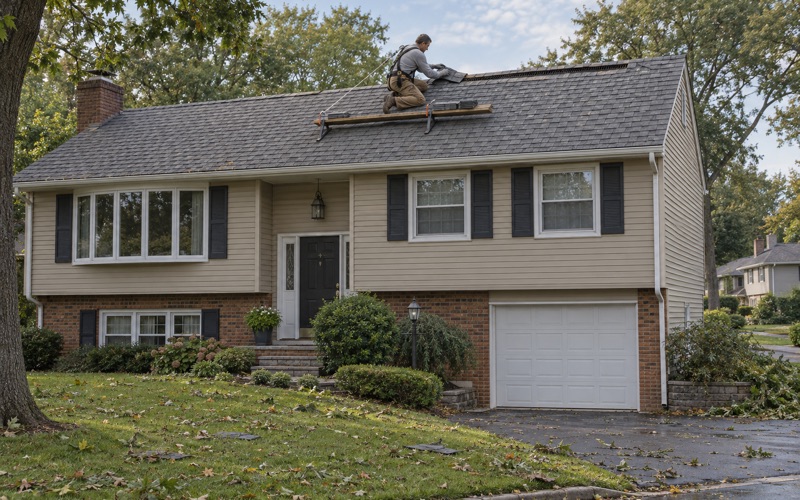
A limb that rubs the roof in wind wears the granules off a strip of shingles, and leaves that collect in a valley hold water against the underlayment long after a storm passes. Shade keeps one slope damp enough to grow moss. Little of that shows from the street, which is why our estimates call out overhanging limbs, leaf-packed valleys and shaded slopes by name.
Gutters suffer too. A tree that drops leaves and seed pods into the same run every fall packs the leaders, and the overflow runs behind the fascia. When we price a roof under a tree, the gutter line is part of the conversation, because new shingles draining into a clogged gutter only move the problem a few feet.
Pruning or Removal: Two Different Questions
Owners often assume a tree has to come down before a roof goes on, and many times it does not. Cutting back the limbs that reach the roof may be all the job needs. The borough’s tree paperwork, covered below, is written around removing whole trees; it says nothing about trimming, so anything short of removal is a question to put to the borough directly.
We are roofers, not tree experts, and we do not decide which trees stay. What we can do is show you, from the roof and the attic, which limbs are touching shingles, which valleys stay wet and which slopes sit in shade most of the day. That gives you something concrete to bring to a tree professional and to the borough.
Looking for roofing closer to Wyckoff? See Roofing in Wyckoff.
The Borough’s Tree Removal Application
Removing a whole tree from a Roselle Park property runs through a one-page Tree Removal Application issued under the borough’s Code Enforcement seal, filed with the borough at 110 East Westfield Avenue. The office section carries a permit number, a payment line and the Zoning Officer’s signature, so the person who signs off on your tree is the Zoning Officer, not the roofer and not the tree crew.
What the Form Asks About Each Tree
For every tree on the application you give its location, species, trunk diameter and condition, marked living, dead or diseased, along with the reason for removal and whether you plan to replace it. Diameter is measured at 4 1/2 feet above ground level, the standard diameter at breast height. If a tape around the trunk is easier, the form accepts the circumference divided by 3.14.
The form also asks for supporting written statements, photos, reports or testimony from a licensed tree expert. For a homeowner, that means the application is easier to complete with a tree professional involved from the start, since their assessment of condition and risk is the evidence the Zoning Officer reads.
The Sketch of House, Driveway and Trees
Every application needs a tree removal plan: a survey or sketch of the property showing the house, the driveway and any accessory buildings, with each tree to be removed marked with an X. On the borough’s R-1 lots, which the zoning code sets at 5,000 square feet with 50 feet of frontage, the tree over the roof is rarely far from the house or the garage.
If you already have a survey from your closing, it is the simplest base for the sketch. If not, a clear hand drawing that shows where the tree stands against the house and driveway is what the form describes. When we inspect, we note which side of the house the tree affects, which helps the sketch match what the roof shows.
One Tree in Five Years, Then Replacement or a Fee
By signing the application, the owner agrees that any tree removed or destroyed will be replaced with a similar tree or covered by the requisite replacement fee based on the borough’s Tree Replacement Requirements Table. That is the default. The form then carves out two exceptions, and whether either applies decides if the tree work behind your re-roof ends with a new planting, a payment or neither.
The One-Tree Allowance
Residents may remove one tree per property within a five-year period without being subject to the replacement policy, as long as that tree measures under 33 inches at breast height. On the form it is a checkbox: under 33 inches, and no other trees removed during the past five years. If the tree over your roof is the first one off the lot in five years, this may be the path.
The allowance is counted per property, which matters on a house that has changed hands recently. Before relying on it, ask the Zoning Officer whether any earlier removal is on record for your lot. A second tree inside the five years, or any tree of 33 inches or more, falls back to replacement or the fee, unless it is proven a hazard.
Replacement Tree or Fee in Lieu
The form offers two boxes for that case: replace the tree, or pay a fee in lieu. The fee comes from the borough’s replacement table, which is not printed on the application, so ask the Zoning Officer for the current figure before you decide. We do not quote it, and we would rather you hear it from the office that sets it.
The State Model Behind the Form
Roselle Park’s form follows a statewide requirement. Every municipality holding a Tier A stormwater permit had to adopt and enforce a tree removal and replacement ordinance by May 1, 2024, and the NJDEP model ordinance served as the guidance. The model regulates street trees from 2.5 inches and other trees from 6 inches, and calls for one to four replacements depending on size.
The model’s resident exemption counts fewer than four trees per acre under 33 inches within five years. Roselle Park’s form is narrower: one tree per property. On a small borough lot that difference is real, and it is the reason we do not treat a second removal as routine. The model is guidance; the borough’s own terms are what the Zoning Officer applies.
Hazard Trees and the Tree Expert’s Proof
A tree that has been proven to be a Hazard Tree is exempt from replacement, with no planting and no fee. The word that matters is proven. That proof comes from the licensed tree expert the form already asks for, and a dead or diseased trunk leaning toward the house is the kind of case it has to establish.
Separately, the borough’s Shade Tree Committee may remove, trim or require the removal or trimming of any tree dangerous to public safety, including on private property, under Borough Code section 2-36. A tree threatening a sidewalk or street as well as your roof may draw that attention on its own. Our roof photos document what the tree has done to the shingles; they are never offered as a hazard finding.
Sequencing Tree Work Before a Re-Roof
The order of work is simple to state: the tree question gets settled before the tear-off is scheduled. A tree coming down after new shingles are on puts limbs, rigging and falling sections over a roof you just paid for. A tree coming down before means the crew starts on a clear slope and the estimate reflects the roof as it will actually live.
From Inspection to Application
Whatever we found under the canopy goes into the written estimate, so the tree professional preparing the expert statement can work from the same record. If removal is the plan, the application goes to the Zoning Officer, and we hold the roof start until you have an answer rather than booking a crew against a decision still pending.
Timing matters in the other direction too. If a second removal inside five years would bring the replacement table into play, you may decide to prune and keep the tree, and the roof plan changes with that choice: more attention to the valley, the gutters and the shaded slope rather than a slope open to the sun.
When the Tree Stays
A kept tree changes the materials list. We specify a self-adhering ice and water barrier meeting ASTM D1970 along the eaves and through the valleys under the canopy, because wet leaves hold meltwater there long after the rest of the roof is dry. Older capes with ice-dam-prone eaves get that eave membrane together with a ventilation check, not just new shingles.
Ventilation matters more under shade. A slope that rarely sees sun dries slowly, and an attic that cannot breathe adds moisture from underneath, so we check ridge vent and soffit intake on every replacement. Shaded slopes with moss get a note in the estimate, so the owner knows why that side may need attention sooner than the sunny one.
On the Day of the Tear-Off
Once the tree work is done and the roof is clear, the tear-off goes ahead. Damaged decking found under the old shingles is photographed and shown to you before it is replaced, at the per-sheet price written into the contract, and a roof that sat under a dripping canopy for decades is where soft sheathing can turn up.
At the end of every work day the driveway, yard and gutters are cleaned, with a magnet sweep for roofing nails across the lawn. Our contracts follow New Jersey’s home improvement rules, including the three-day cancellation notice. Nothing on the job starts until both the tree answer and the signed scope are in hand.
- 20+ Years on Local Roofs
- Itemized Written Scopes
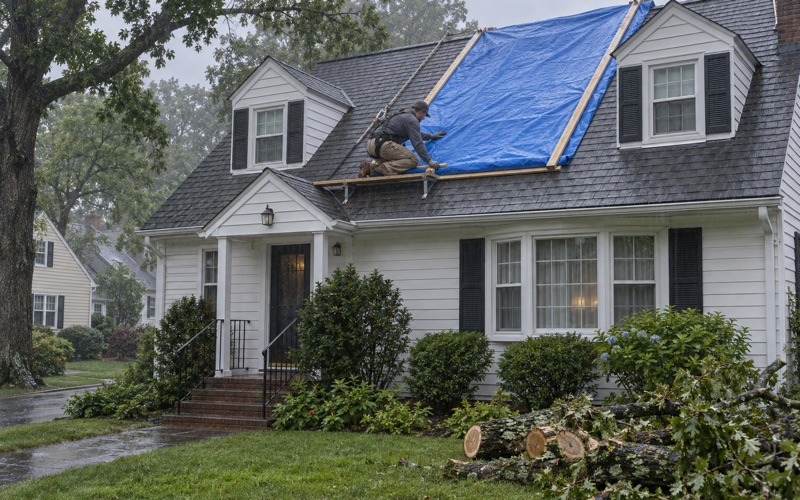
- Same-Day Storm Tarping