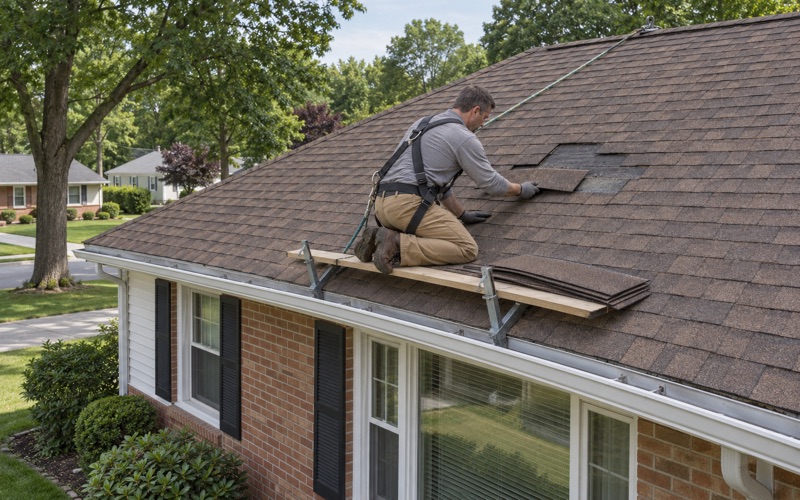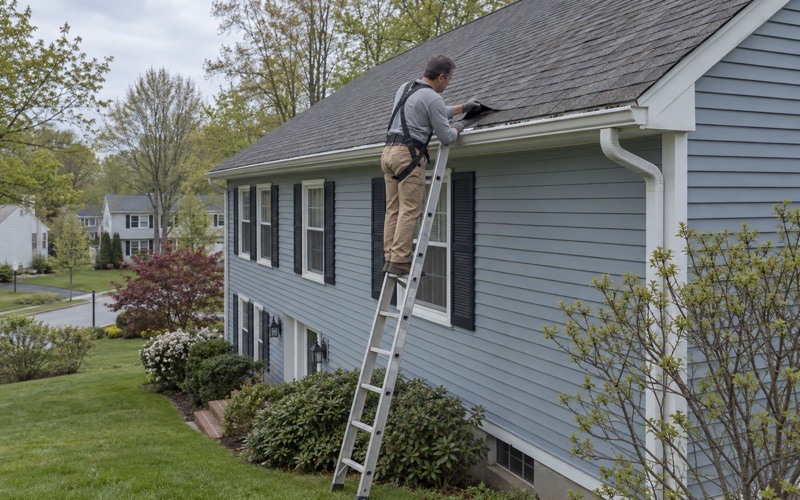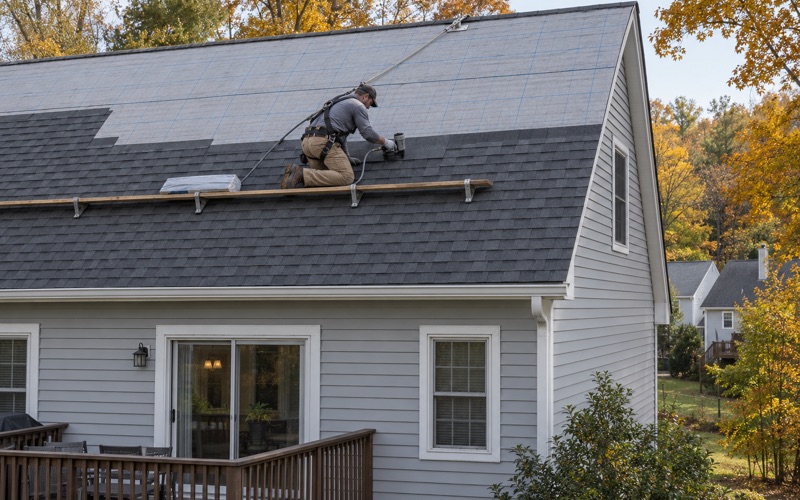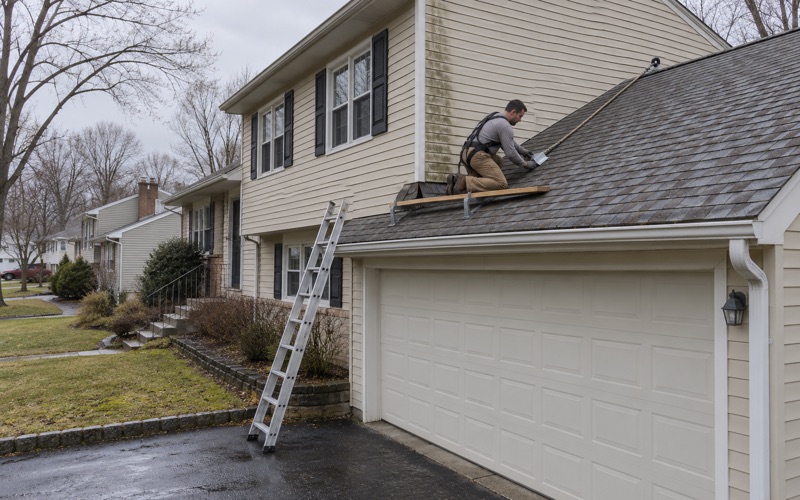
Parsippany Elite Roofing has spent more than 20 years on roofing in Saddle Brook and the rest of North Jersey, and the first question we answer on a call here is rarely about shingles. It is about time. A roof replacement is a short, loud job done a few feet from a neighbor’s bedroom window, and the township decides which hours of the week that noise is allowed.
We plan every Saddle Brook job backward from that schedule. A repair, a tear-off or a flashing rebuild is priced and sequenced so the loud work lands inside the permitted window, the deck is closed up before quitting time, and nobody on the block hears a nail gun on a Sunday morning. That planning is part of the estimate, not something we work out on the driveway.
Before any of that, we tell you plainly whether the roof needs replacing at all. Many leaks on older houses trace back to a cracked pipe boot or tired chimney flashing, and we check from the attic as well as the shingles so the water is followed to where it enters. If a repair will hold, that is what we quote.
When a Roofing Crew May Work in Saddle Brook
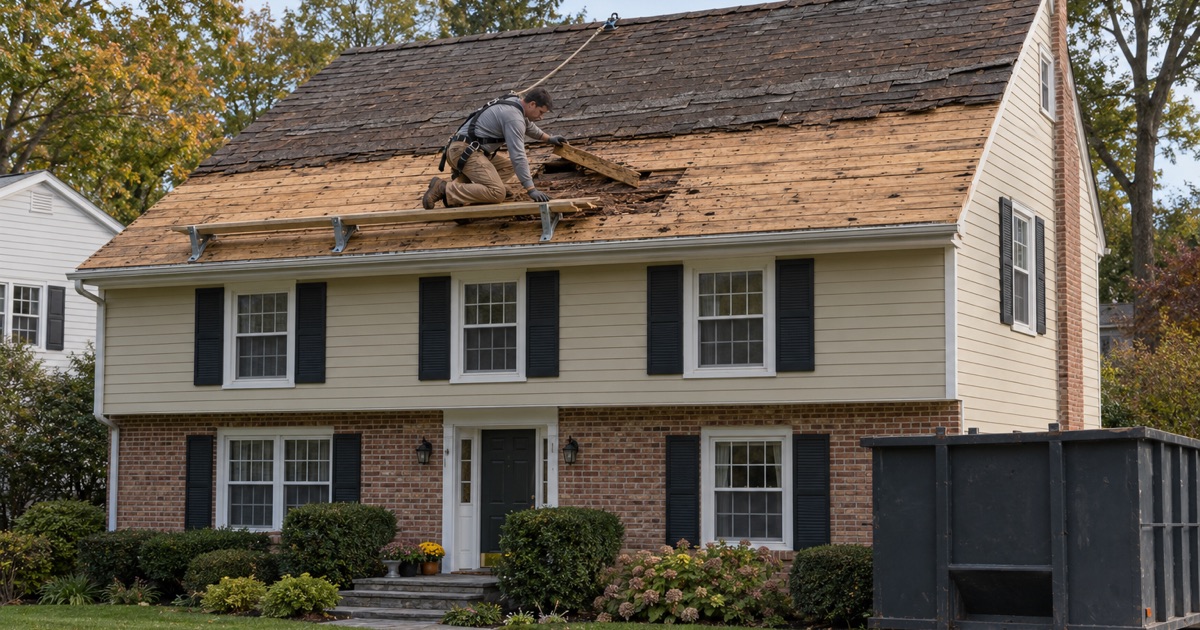
Saddle Brook does not set construction hours through its building office. They sit in the township’s noise rules, which Ordinance 1776-25 rewrites as part of Chapter 147, Peace and Good Order. The ordinance was introduced on March 20, 2025, and the hours below are the ones its text sets out for anyone running construction, repair or alteration equipment.
Weekday hours, 7:00 a.m. to 6:00 p.m.
On weekdays, the ordinance bars that equipment between 6:00 p.m. and 7:00 a.m. the following day, which leaves a working window of 7:00 a.m. to 6:00 p.m. It applies in any land use category, so a residential street gets the same clock as a commercial lot. A weekday, under the definitions section, is Monday through Friday when the day is not a legal holiday.
In practice, our crews arrive and stage before the start, but the compressor, the nail guns and the tear-off itself wait for seven o’clock. We aim to have the last bundle nailed, the ridge capped or the deck dried in, and the cleanup done by late afternoon, so the work day ends inside the window rather than spilling past it.
Material deliveries and power tools
Two other sections touch a roofing job. Section 147-12E limits loading and unloading of building materials between 10:00 p.m. and 6:00 a.m. before a weekday, and between 11:00 p.m. and 7:00 a.m. before a weekend or holiday, where it causes a noise disturbance. Section 147-12J keeps domestic power tools outdoors in residential zones quiet from 8:00 p.m. to 8:00 a.m. on weekdays.
We book shingle and underlayment drops for daytime hours, so a boom truck never idles on a residential street before dawn. Because the delivery lands on your driveway or lawn edge, we note where it will go in the estimate and protect the surface underneath. The same planning keeps our trailer from blocking a neighbor’s driveway at the start of the day.
Fines and the 24-hour notice
Section 147-14 sets civil penalties of $25 to $500 for a first offense and $250 to $750 for a second, and each day a violation continues counts as a separate offense. Under Section 147-10, enforcement can begin with a written abatement notice giving 24 hours to stop the noise in place of a summons.
A fine on a roofing job is a scheduling failure, and nobody on either side of the contract wants one. We would rather add a day to the calendar than run a saw at half past six, and we tell you at signing exactly which days the crew will be on your roof.
Looking for roofing closer to Wood-Ridge? See Wood-Ridge Roofing.
Saturdays, Sundays, Holidays and Storm Emergencies
The weekend rules are where most Saddle Brook schedules get tight. A tear-off that starts on a Thursday has fewer hours to finish than one that starts on a Monday, and a project that crosses a holiday weekend can lose two working days in a row. We plan around those gaps before the old roof comes off, not after.
Saturday work, 9:00 a.m. to 5:00 p.m.
On Saturdays, Section 147-12F bars construction equipment from midnight to 9:00 a.m. and from 5:00 p.m. to 11:59 p.m., so the usable window is 9:00 a.m. to 5:00 p.m. That is eight hours against eleven on a weekday, and a tear-off on a steep, cut-up roof may not fit inside it.
We usually keep Saturdays for shorter tasks: ridge vent, drip edge, pipe boots or a second crew finishing gutters and leaders. The full strip-and-dry-in days stay on weekdays, when there is room to deal with soft decking and still have the roof sealed before the clock runs out. No section of roof is left stripped under a tarp from Saturday afternoon until Monday morning.
No Sundays and six holidays off
The ordinance bars construction equipment at any time on Sundays. It does the same on New Year’s Day, Memorial Day, Independence Day, Labor Day, Thanksgiving and Christmas, whatever day of the week they fall on. A scheduled re-roof is not exempt from any of this, and we will not offer to work through one of those days to finish sooner.
Late May, early July and early September are busy roofing weeks, and each one carries a holiday. When your project lands near one, the written schedule shows the holiday as a dark day so the gap is expected rather than discovered. If weather has already pushed the start, we would rather slide the whole job a week than leave a roof open over a long weekend.
Emergency tarping after a storm
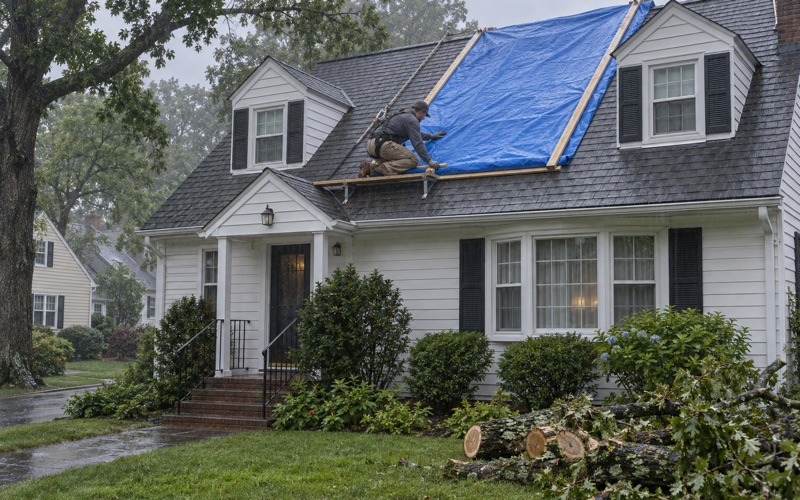
The one exception that matters for roofing is emergency work. Section 147-13e exempts construction or repair noise done for emergency work, which the definitions section describes as work needed to restore property to a safe condition after a public calamity, or to protect people or property from imminent danger. A wind-torn roof with water coming through the ceiling can fit that description.
After a wind storm we put tarps and temporary repairs on the same day, photographing the damage before anything is moved. Those photos and a written damage report go to you for your own insurance claim, and if you ask, our crew will meet the adjuster on site. The permanent repair or replacement that follows is ordinary scheduled work and goes back on the normal weekday clock.
Planning a Tear-Off on a Postwar Saddle Brook House
The housing stock explains why the clock matters so much here. Census estimates (ACS 2024 5-year) put 47.4 percent of the township’s homes in the 1940 to 1959 build years, and 64.0 percent of all units are detached houses. Most re-roofs here are on a detached house about 65 to 85 years old, standing a driveway’s width from the one next door.
What an older roof hides
A house that age is often on its third or later covering, and the layers underneath tell us what the tear-off will involve. When there are already two or more layers, the state rehabilitation subcode requires a tear-off rather than another layer on top. Stripping several layers takes longer than stripping one, which is exactly where a weekday window gets used up.
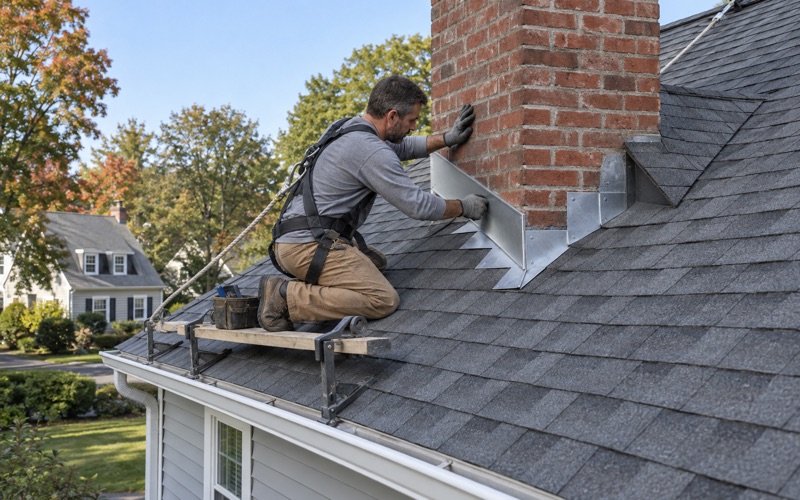
Once the old roof is off, we photograph any rotted or delaminated decking and show it to you before a sheet is replaced, at the per-sheet price written into the contract. Step, counter and chimney flashing is replaced with the roof rather than reused, and the attic ventilation is checked so the new shingles are not cooked from below.
How the days are laid out
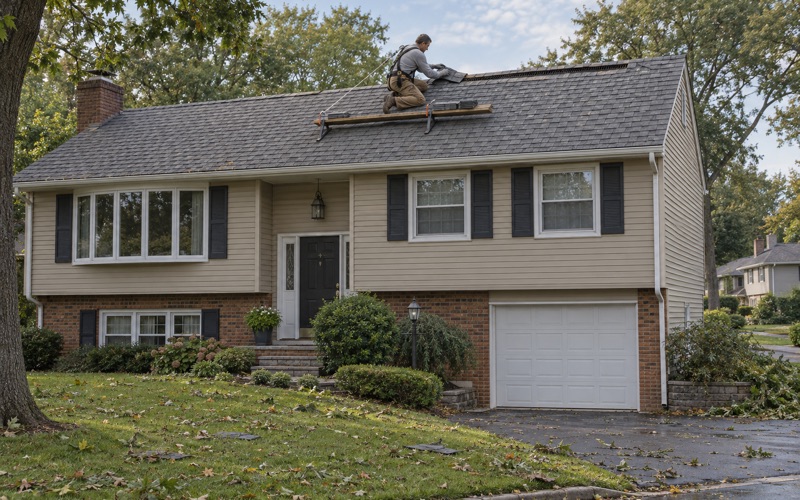
On a house of that era, we strip and dry in one slope at a time, so a sudden afternoon shower never finds open deck. Underlayment, ice and water barrier at the eaves, drip edge and new shingles follow the same day on each section. The goal is a roof that is closed before quitting time each day, whether or not it is finished.
We also clean the driveway, yard and gutters at the end of every work day, magnet sweep included, so loose nails do not sit overnight in a shared side yard. Your written scope lists tear-off, decking, underlayment, flashing, ventilation and gutters as separate lines, which makes it easy to set our estimate next to another one.
Ice dams on older eaves
Eaves on houses from that era were built long before self-adhering membranes were common. On replacements we add an ASTM D1970 self-adhering ice and water barrier along the eaves and check the ventilation that keeps snow from melting and refreezing there. It is a detail that takes little of the schedule and saves a stained ceiling later.
Two-Family Houses, Tenants and Your Neighbors
The second common building type here is the two-family house. Census estimates count 873 units in two-unit buildings, about 15.5 percent of the total, and 695 of the occupied ones are rented against 104 lived in by their owners. One roof often covers an owner’s flat and a tenant’s flat, or two rented flats.
Working around tenants
With people living under both halves of the roof, the work hours matter twice. We give the owner a written schedule to pass on, naming the days of tear-off and the hours the crew will be overhead, so tenants can plan around the noise. Access to the attic, when it runs through the upper unit, is arranged with the owner before the first day so nobody is surprised at the door on day one.
Notice for the houses next door
On lots this close together, the neighbors hear every hour of a tear-off and often watch the work from their kitchen window. We protect shared fences and plantings, keep ladders and staging on your side of the line where the lot allows, and suggest you let the houses on either side know the dates. A complaint is far less likely when the people next door already know the schedule.
Calling the township before work starts
The Township of Saddle Brook Building Department, at 55 Mayhill Street, asks residents to contact it before beginning any work to find out whether a permit is required. We suggest that call for any roofing project, and we can tell you what to ask about your particular house. The state’s ordinary maintenance rule covers roof covering on detached one- and two-family dwellings, but the department’s own answer is the one to rely on.
Our contracts follow New Jersey’s home improvement rules, including the three-day cancellation notice, and the schedule we attach to them is built around the township’s hours from the first day. If you have a leak, a tired roof or storm damage on a Saddle Brook house, call us and we will look at the attic and the roof before we talk about price.
- 20+ Years on Local Roofs
- Itemized Written Scopes
- Same-Day Storm Tarping