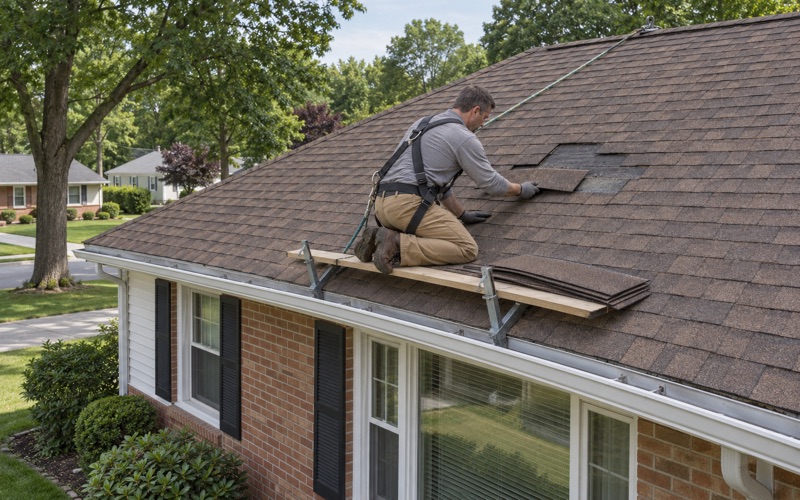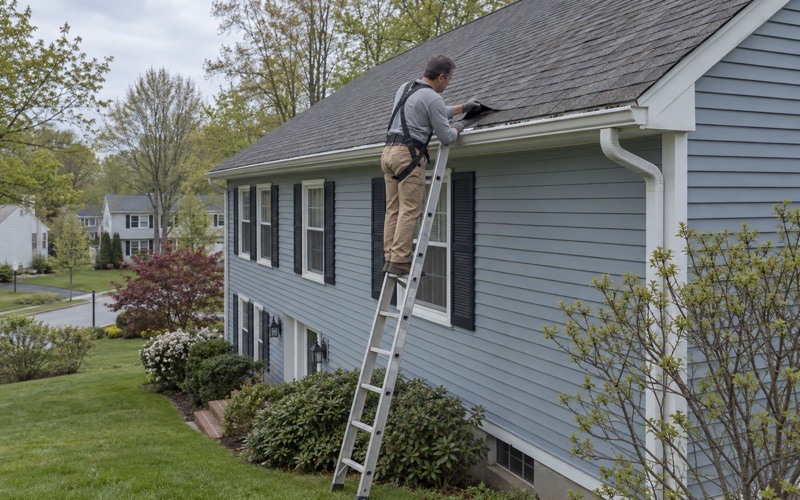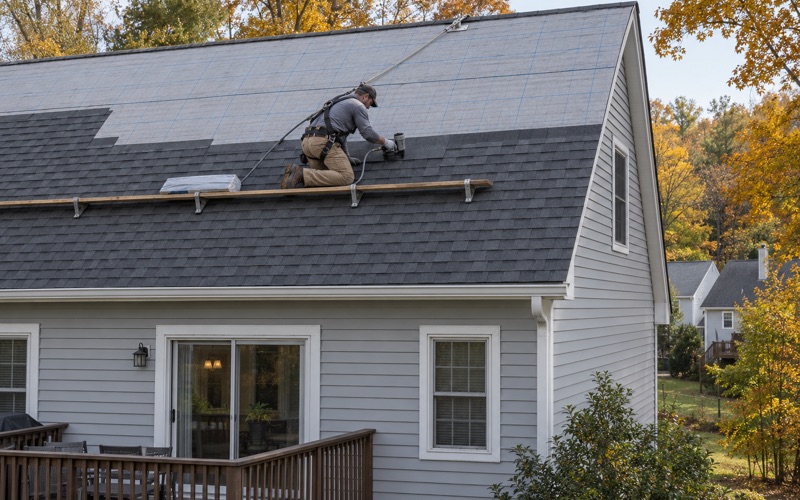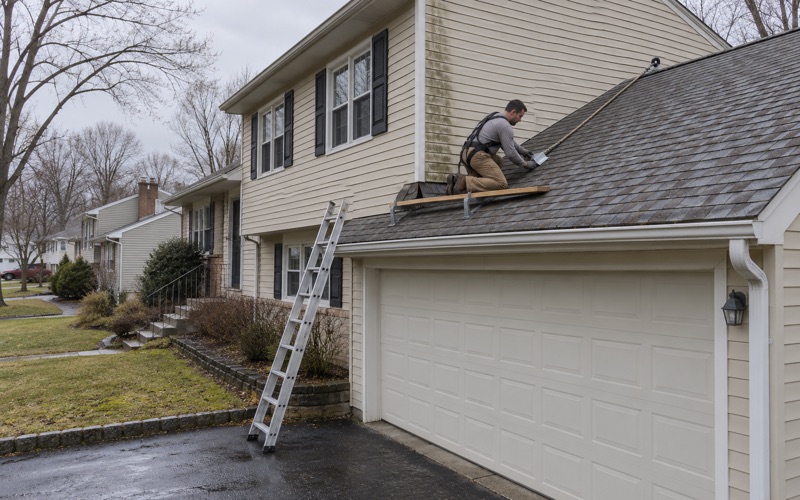
Parsippany Elite Roofing handles roofing in Springfield Township for owners of detached houses and attached townhouses alike, bringing more than 20 years of roofing experience from our base in Parsippany. Our first question on any call is a simple one: who actually holds this roof? In a detached home the answer is the owner, but in a condominium the governing documents can say something very different.
That question matters because the paperwork decides who can hire us. When a leak belongs to an association, an owner who calls a roofer directly can end up paying for work the association never approved, or for a repair that may have to be redone to match the rest of the building. We read the documents first and tell you plainly where your call should go.
Springfield owners who do hold their own roofs get the same treatment we give any house: a look at the problem from inside and out, a straight answer, and a written scope. Owners whose roofs belong to an association get something just as useful, which is a clear explanation of why the call belongs with their board.
Springfield Park Place: 312 Townhouses Under One Master Deed
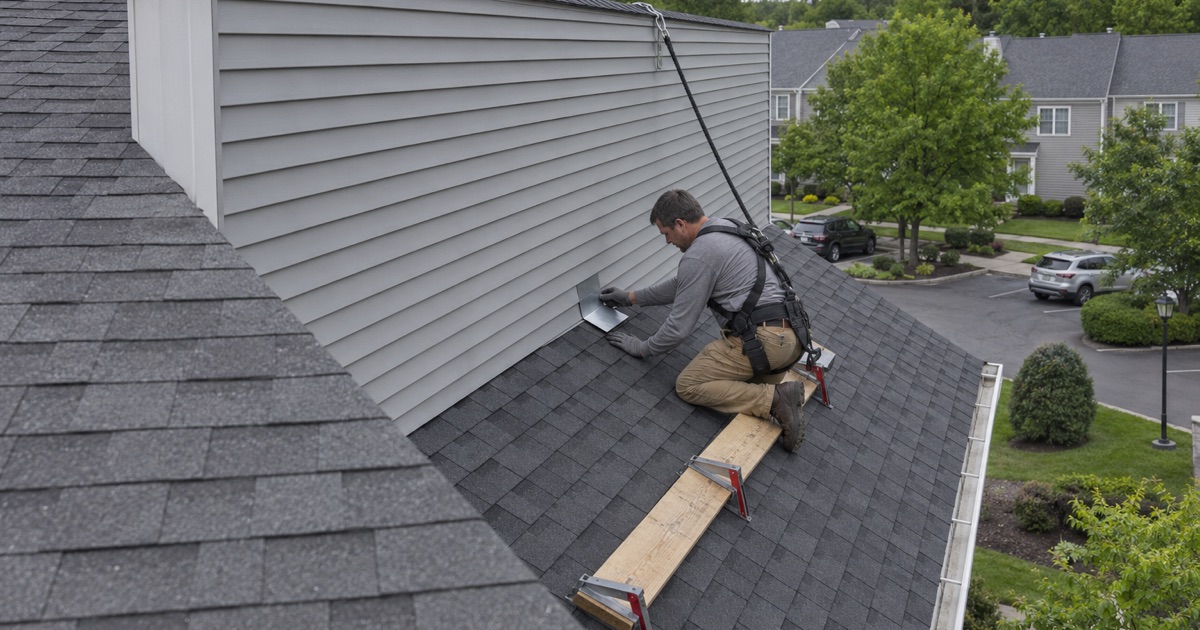
Springfield Park Place is the largest condominium we have found documented in the township, and its master deed is a public example of how these communities divide a roof. The deed, dated 1988 and posted on the association’s own site, describes 312 townhouse units in 53 buildings on approximately 53.2 acres. It also places four office buildings of about 210,000 square feet, a retail strip of roughly 11 stores, a pool and a tennis court inside the same condominium.
That mix is why the deed sorts its common elements into groups rather than treating the whole property as one roof. The townhouse buildings get their own category, and the office and retail buildings are dealt with in separate sections we do not cover here. If you own one of the townhouses, the section that matters for your roof is 5.02(b).
Section 5.02(b): A Roof the Association Maintains
Section 5.02(b) lists the roof, attic space, foundations, footings, columns, girders, beams, supports, bearing walls and floors of the townhouse buildings as Residential Limited Common Elements. The deed then states that any repairs, maintenance or replacement costs for those elements shall be the responsibility of the Association. Put simply, the shingles over a Park Place townhouse are not the owner’s to replace.
Section 7.03 completes the picture by charging residential limited common expenses only to the townhouse owners, so the office and retail owners do not share that bill. Section 8.03 adds one exception worth knowing: damage that an owner, a household member, a pet or a guest causes to common elements is charged back to that owner. A ladder dragged across the gutter line can become a personal expense.
Where the Unit Ends and the Common Element Begins
Section 4.01 sets the top of each townhouse unit at an imaginary plane along the unfinished, unexposed surface of the gypsum board forming the uppermost ceiling. Everything above that plane, from the attic framing to the shingles, sits outside the unit. A water stain on a top-floor ceiling is therefore often the visible end of a problem that starts in space the owner does not hold.
Decks and patios are handled differently. Under Section 5.03, as amended in December 2001, they are Townhouse Limited Common Elements, and the owner handles snow clearing and ordinary repairs. Where a deck meets the wall below a roof edge, we note which side of that line each piece of flashing falls on, so nobody pays for the wrong half.
Looking for roofing closer to Berkeley Heights? See Roofing in Berkeley Heights.
Reserves, Loans and Special Assessments in the 2026 Budget
Because the association carries the roof, the money for it comes out of the community’s budget rather than one owner’s checking account. Section 7.01 requires assessments at least sufficient to maintain the exterior of the buildings. The 2026 operating budget prepared by FirstService Residential, the community’s management company, shows what that looks like on paper.
Reserve Funding and Deferred Maintenance
The 2026 budget sets aside $465,000 for reserve funding, up from $450,733 the year before, plus $70,000 for deferred maintenance. Total reserve expense comes to $569,500 against $2,142,993 of association fees. The budget page says budgets are discussed and approved at the first open meeting of the year, which is the place to ask how the roofs figure into those reserves.
Gutter maintenance is a smaller line, budgeted at $4,500 for 2026 compared with $10,000 for 2025. We do not know what that change reflects, and we would not guess. What it does suggest is that gutters on these buildings are handled as an association expense, so a clogged leader above your door belongs on a work order rather than a weekend list.
The Loan Line and the $25,000 Rule
The budget also carries $358,050 for loan principal and interest, the same figure as 2025, and $46,650 of special-assessment income that did not appear the year before. The budget does not say what the loan financed, so we make no claim about it. Owners who want to know can ask the board directly.
The master deed also governs how new money is raised. Under Section 7.06 the board may levy an emergency lump-sum assessment without the consent of any unit owner, but Section 7.07 requires two-thirds of the owners’ aggregate votes for special assessments exceeding $25,000 for any assessment year. A large project, in other words, usually becomes a community decision.
Reporting a Leak, Satellite Dishes and Exterior Changes
In Park Place, a leak goes to the management office before it goes to a roofer. New Jersey’s Condominium Act, at section 46:8B-18 of the statutes, bars a unit owner from contracting for repair of common elements except through the association. An owner who hires a roofer independently is working outside that rule, however urgent the drip feels.
What to Do When Water Comes Through
Photograph the ceiling, note the date and the weather, and send them to the management office along with your unit number. If the water is reaching belongings, move them and put a container down, but leave the attic hatch and the roof alone. Opening up a ceiling or walking a roof can blur what the association’s contractor needs to see.
The association’s FAQ also tells owners to carry an HO6 policy, noting that dwelling coverage is less extensive because the association buys insurance on the building. We have not read either the master policy or any owner’s HO6 terms, so we cannot tell you which one responds to a given leak. Your insurance agent and the management office are the people to ask.
Satellite Dishes and Exterior Modifications
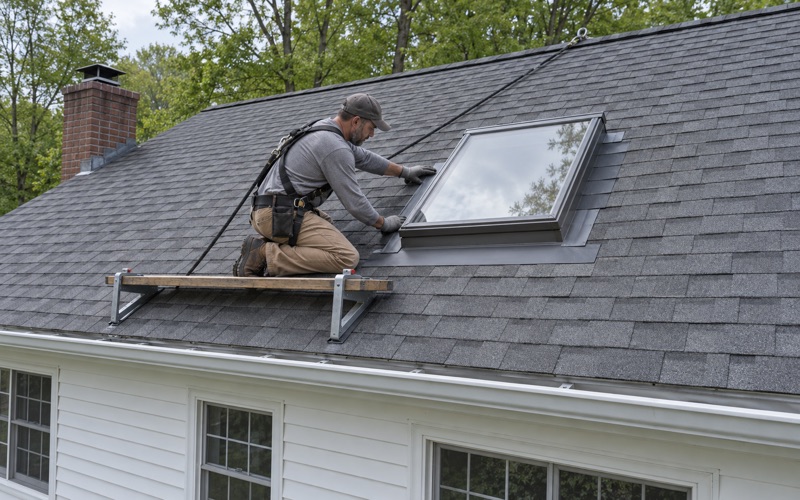
The same FAQ says satellite dishes are not permitted on the roof or siding of any building. Any modification, alteration or addition to the exterior needs written approval from the Board of Directors before installation, with a Property Modification Application and Restrictive Covenant submitted first. An owner picturing a skylight or a new vent should begin with that paperwork, not a contractor.
Permits for Attached Buildings
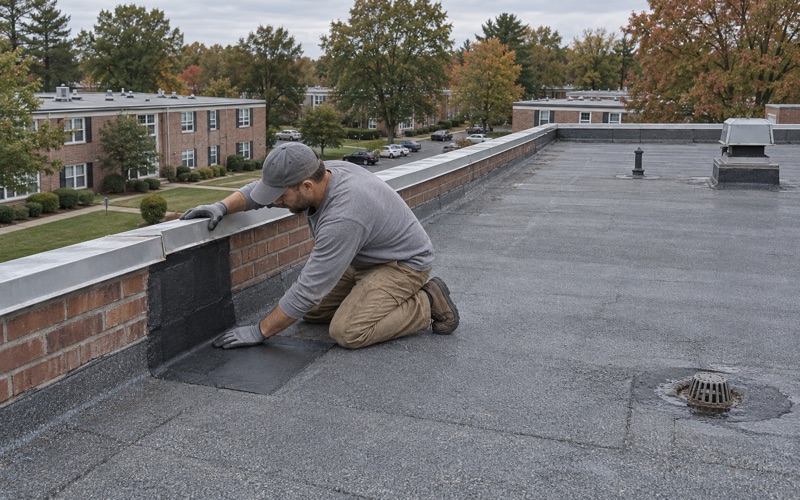
Re-roofing an attached townhouse building is construction permit work in New Jersey. The ordinary-maintenance exemption in New Jersey Administrative Code 5:23-2.7 covers roof covering on detached one- and two-family dwellings only. Permits for Springfield work go through the Springfield Building Department at the Engineering Annex Building, 20 North Trivett Avenue, where the construction official sees people by appointment.
The building department’s page also reminds owners and contractors that they are responsible for requesting and completing every required inspection. A project should not be considered complete until all of them are done. For an association job, that means the board should expect the contractor it hires to pull the permit and see it through to final inspection.
How We Approach Roofs Across Springfield
Not every Springfield home sits under an association. The latest five-year Census estimates count 4,511 detached houses among Springfield’s 7,277 housing units, and owners occupy 237 attached units plus 217 units in buildings of three or more. Before we price anything at an attached address, we check the association’s documents to confirm who holds the roof.
Attic First, Then the Roof
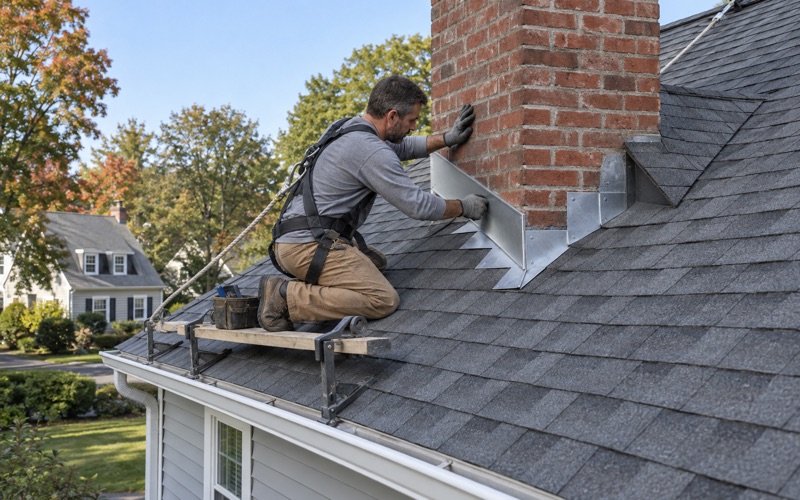
Every leak call includes a trip into the attic as well as onto the roof. Water often travels along a rafter or the underside of the sheathing before it shows on a ceiling, so the stain and the entry point can sit several feet apart. Tracing it first keeps us from pricing a fix in the wrong place.
When the roof can be repaired, we say so before replacement comes up at all. If an association or its manager asks us to look at a townhouse building, the same attic-first method applies, and our findings go back to them in writing rather than to an individual owner. That keeps the decision where the master deed places it.
Itemized Scopes and Decking Photos
Our written scopes break tear-off, decking, underlayment, flashing, ventilation and gutters into separate lines, which helps a board or a homeowner compare competing bids item by item. If rotten decking turns up once the old roof is off, we photograph it and show you before replacing it, at a per-sheet price already set in the contract.
Step, counter and chimney flashing are replaced with the roof instead of being reused under new material, and attic ventilation is checked on every replacement. Contracts follow New Jersey’s home improvement rules, including the three-day cancellation notice, and the driveway, yard and gutters are cleaned at the end of each work day with a magnet sweep for nails.
Older Detached Homes and Storm Calls
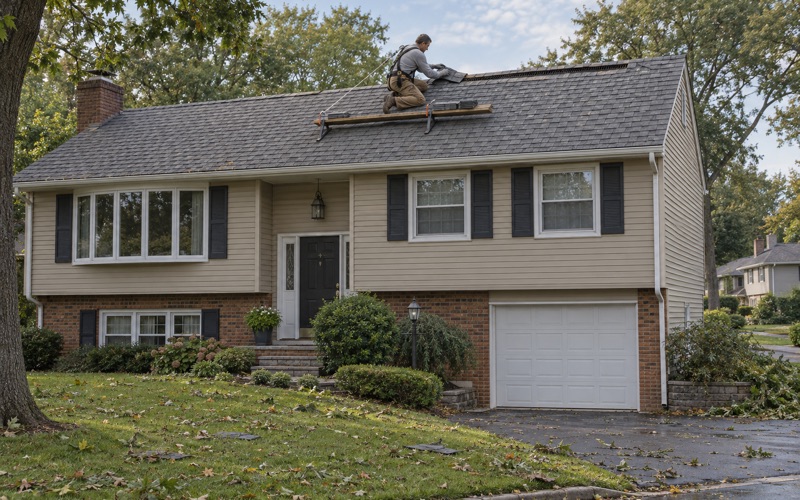
Springfield’s population roughly doubled during the 1950s, from 7,214 to 14,467, and Census estimates date 2,058 housing units to that decade alone. On older capes and split-levels with ice-prone eaves, we add an eave membrane and check ventilation rather than simply laying new shingles over the old problem.
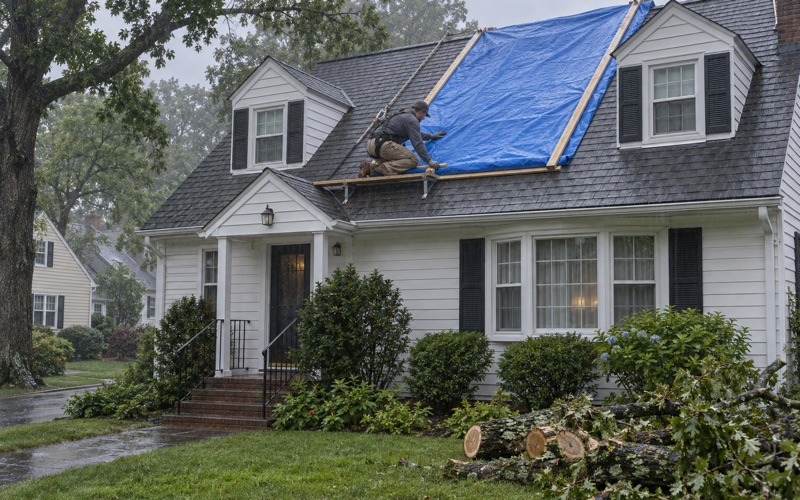
After a wind storm, tarps and temporary repairs go on the same day, with photos taken before anything is moved. We photograph and write up storm damage for the owner’s own claim and will meet the insurance adjuster on site when asked, though the claim itself stays between you and your insurer. At a Park Place townhouse, all of this starts with a call to the management office.
- 20+ Years on Local Roofs
- Itemized Written Scopes
- Same-Day Storm Tarping